Specifying Starches
They act to thicken, gel, stabilize, provide body, bind water, add bulk, reduce fat, form films, and prevent sticking. In soups, they thicken and add creaminess, and can increase pumpability during processing while providing very little final viscosity.
Food scientists first learn about starches in a Carbohydrates 101 course. Fundamentally, starch is a polysaccharide made of long chains of glucose: linear amylose molecules and branched amylopectin molecules that typically comes from sources such as corn, tapioca, wheat, rice and potato. Instruments from companies such as C.W. Brabender Instruments Inc., South Hackensack, NJ, are used to measure key attributes such as viscosity.
“Product developers should realize that all starches are not created equal,” says John Mitolo, technical service manager for National Starch & Chemical Co., Bridgewater, NJ. “There are huge differences in functionality and performance between them.” Starch suppliers work with customers to give them the optimal product for a specific application.
Viscosity Values
A good place to start when selecting starches is to read through supplier literature. Technical data sheets are available for comparisons of viscosity, moisture, pH, freeze/thaw and heat/shear stability, clarity and other parameters.Viscosity is an important property of starches, and indicates its utility in specific applications. When starches are heated in an aqueous suspension, they gelatinize, i.e., they absorb water and swell irreversibly, creating a thick or viscous paste. Upon cooling, the amylose molecules reassociate, a phenomenon known as retrogradation or “setback.” Generally, this is undesirable. Liquid is squeezed out of the system, as demonstrated by the watery surface on puddings. This “syneresis,” or weeping, can be controlled by modifying starches.
As the starch granule expands with the uptake of water, clarity and viscosity increases. Waxy maize has little or no linear amylose molecules, so its paste remains flowable and clear, without weeping or gelling.
Rheological behavior of a starch involves studying its viscosity, elasticity and plasticity. Food processors measure starch viscosity as a quick assessment of product performance.
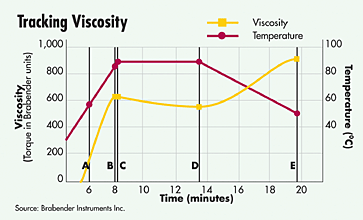
The most common method for observing rheological starch behavior is studying viscosity changes during a programmed heating, cooking and cooling cycle. For example, using a Brabender ViscoAmyloGraph® (VAG), heating rates are typically held at about 1.5 °C/min. while a starch solution is placed under agitation. After a holding period of between 10-30 minutes at about 90 to 95 °C, the sample is cooled at the rate of 1.5 °C/min. The viscosity is recorded as a function of temperature. The viscosity curve that is generated (see chart) indicates the beginning of gelatinization, the gelatinization maximum and temperature, the product's viscosity during holding, and the viscosity at the end of cooling.
“The [instrument] helps food formulators get a fingerprint of the starch to simulate its behavior during production,” says Sal Iaquez, sales & marketing manager/food equipment for C.W. Brabender Instruments. “Whether you are blending thickeners, altering your formula, evaluating starch potential, or developing prototypes, this instrument gives valuable information during the product development phase.” The rheological properties of a starch change throughout the food processing process, during gelatinization, retrogradation and any freeze-thaw cycles. These properties are influenced by starch source, concentration, temperature, heating rate and mechanical treatment. The addition of lipids, proteins, sugars, salts and other ingredients, influences the properties.
“Whether you are looking for greater initial viscosity, or you are interested in pumping, shearing, heating or mixing a product in the plant, viscosity measurements give you an idea how much process tolerance is built into the starch,” states Mitolo.
Other viscosity tools commonly used in the food industry include the Brookfield viscometer and Bostwick consistometer. Their use depends on the application and purpose—whether as a QC check or an R&D tool.
Trends in Starches
The demands of processing and product performance dictate that starches withstand high shear rates, low pH values, high or low temperatures, and other rigorous parameters. In addition, in many instances, starches must withstand freeze-thaw cycles and microwave heating. Chemical and/or physical modification of starches helps meet these requirements.However, for products that want an “all natural” designation, suppliers have developed functional native (unmodified) starches that can meet these harsh demands. They can be labeled simply as the starch source—such as “corn starch” or “rice starch.”
While native starches generally show poor freeze-thaw stability, some native starches—such as rice starch—perform better under these conditions. “We selected waxy rice as a starting material because, inherently, it has improved freeze-thaw stability properties,” says Mitolo of his company's functional waxy native rice starch line.
Starches also can be pregelatinized (instant or precooked) so that no heat is required to develop viscosity. These starches are either traditional “drum-dried” starches or cold water-swelling starches (in which the starch granules remain intact and give similar viscosity to “cook-up” starches).
While corn starches continue to dominate the U.S. starch market, other starch sources should also be considered, depending upon the application.
“Potato and tapioca starches are very complimentary to each other,” says Sally Brain, director of marketing, food and new business for Avebe America Inc., Princeton, NJ. “Both have a very low flavor profile due to their lower lipid and protein contents, compared to corn starches.”
In general, root and tuber-derived starches tend to have blander flavor than cereal-based starches. This can be an important consideration in delicate applications. Tapioca, for example, gives a very smooth and creamy texture and is popular in dairy applications such as puddings.
Potato starch has a very high viscosity and slightly pulpy texture because of its extremely large starch granules. It has the highest viscosity of any of the commercially available starches, says Brain. Potato starch can be used at a lower usage level of about 25-35% less, compared to other starches. Applications include meat products, tomato-based sauces, fruit-based fillings and other applications.
“We are educating our customers about potato and tapioca starches—there are many misperceptions regarding functionality and cost,” says Brain. “Based on our viscosity data, modified waxy maize can be replaced on a one-for-one basis with our tapioca starches,” she notes.
Clarity also is very good with potato and tapioca starches. “In dressings, gums can be replaced with potato starch for greater clarity, and better flavor release, and texture.”
Organic ingredients are gaining in popularity. Organic starches on the market include those derived from potato starch, tapioca, and waxy maize.
Sidebar: Through Thick and Thin
Brabender Viscographs have been a staple in the food industry for over 60 years. They entered the computer age during the last decade with full automation. With the recent trend toward diminutive equipment, Brabender now has a miniature viscograph that provides quick results with sample sizes four to five times less than the standard instrument.“A standard starch profile gives a peak viscosity within a 40-45 minute range,” says Iaquez. “The total test time for heating, holding and cooling takes about 90 minutes.” Instruments are now available that give a peak viscosity in seven to nine minutes, with the total test time taking less than 20 minutes. Procedures can even be modified to get a peak after five minutes, with a total pasting curve time of about 12 minutes.
The standard instrument can range in heating/cooling rates from 0.5°C/min. to 4°C/min. The newer instrument ranges from 0.5°C/min. up to 10°C/min. for more rapid gelatinization. The results are comparable to the standard viscoamylograph. The line charts displays the type of results gained from a viscogram of cornstarch.
Point A - With the temperature at 74.4°C, the viscosity begins to rise. This is the pasting temperature and it varies with starch type and modification. It is about 60°C for potato starch and about 75°C for cornstarch.
Point B - Maximum or peak viscosity (632 Branbender Units or BU) is reached after 8:15 minutes have elapsed and at a temperature of 92°C. This is a measure of the thickening power of a starch. Potato starch shows a very high peak viscosity, compared to corn starch.
Point C to D - During a five-minute holding period at 92°C (and a time lapse of 8:24 to 13.24 minutes), the viscosity drops only slightly from 626 BU to 544 BU. This indicates the starch paste has good viscosity stability during cooking—under relatively low shear.
Point E - The viscosity of the cooked starch paste, after cooling to 50°C, is a measure of the retrogradation (setback) produced by cooling. The starch increases in final viscosity to 919 BU. The sharp increase in viscosity indicates strong setback.
Links
- Type phrases such as “modified starch” or “native starch” or “rice starch” or “viscosity” into the search field for specific information
- Oregon State University presentation of basics and terminology
- Type “starches” in search field
- International Starch Institute; general information
- Brookfield Engineering Laboratories; equipment for measuring viscosity and general viscosity information
- C.W. Brabender website on instruments
Looking for a reprint of this article?
From high-res PDFs to custom plaques, order your copy today!