Hearty Cooking in Louisiana

To understand the cuisine of Louisiana, try to visualize a huge cooking pot simmering with foods from France, Portugal, Spain, Mexico, the Caribbean and even from the American Choctaw Indians, being stirred up with soul. That is true flavor and laissez les bon temps roule: let the good times roll right onto your palate. Do not try to sort out those different ethnic contributions--just enjoy the great taste of Louisiana cooking.
Much already has been said and written about Creole and Cajun foods, the major cuisines of Louisiana. But other influences also have affected the region's cooking. The Cajuns in the Western bayous were very close to what once was Mexico, and the food influences were in the form of hot peppers, spices, salsas and tamales. There is a band of land that used to be called “The Neutral Strip” (located approximately along the Texas-Louisiana border), where the Spanish built a fort in 1717 at Los Adaes. As a result, in the town of Zwolle, La., there is a “tamale fiesta” every October. South of New Orleans, toward the mouth of the Mississippi, in Plaquemines parish, the “Islenos” have their own cuisine, which may be Spanish or Portuguese, depending upon whom you ask. Emigrating from the Canary Islands as fisherman, they call their soups “caldos,” and their jambalaya is “paella.” That area is rich in seafood harvest but also is the producer of most of Louisiana's citrus, including the delicious satsuma.

A Long Journey
Cajuns seem to have more fun, and they always start with food. Acadians--or Cajuns--left southern France to live in Nova Scotia in the 1600s. When England took over Canada in 1755, the Acadians lost their home. Eventually, most settled in the swamps west of New Orleans, and this area became known as Acadiana. A Cajun folk tale relates their crawfish are actually descendants of the lobsters that followed the Acadians from Canada to Louisiana, and that it was such a long trip that they, unfortunately, shrunk. The Cajuns were farmers, and by the 18th century they were producing pigs, chickens, corn and rice. The bayous were rich in game and seafood, and the farmers were self-sufficient. The corn may have been the gift of nearby Choctaw Indians, who also enlightened the Cajuns about the sassafras tree. Root beer comes from the sassafras root and bark, and its dried leaves provide file' gumbo, used as a seasoning. As they were accustomed to eating lots of soups, much of the Cajun cooking relied on “one pot” dishes. Other Cajun ingredients include: andouille and boudin sausage, bay leaves, dark cane syrup, cayenne peppers, wild game, pecans and yams.
Several producers of staple Louisiana food products are in Acadiana. Two items found on most Cajun and Creole shelves, Steen's Cane Syrup and Mahatma Rice, come from Abbeville, La. Chef John Folse, who produces his own extensive line of Creole and Cajun products, recently has started making Creole Cream Cheese in a dairy subsidiary of his food manufacturing complex. In New Orleans, there are several coffee roasters, big and small, and coffee with chicory remains very popular. Louisiana's best-selling hot sauce is made in New Orleans under the Crystal brand, but several other manufacturers throughout the state also produce this popular, all-purpose condiment.
A Melting Pot of Cooking Styles
New Orleans' foods are known as Creole cooking, a blended mélange of many European cuisines with an added influence from Africans who worked in New Orleans kitchens. Some of Escoffier's classic sauces were modified to suit the Cajun and Creole taste and became etouffees (a dark brown sauce with tomatoes, used to “smother” protein in cooking), inky-black dark roux (to make very dark gumbos) and a distinctly different court bouillon (in New Orleans, it is not a fish stock, but a tomato sauce very much like a Creole sauce, used for redfish).In New Orleans, Bordelaise sauce has become a butter sauce with shallots and garlic, served with angel hair pasta. The cooks in New Orleans use sauté pans as often as Cajuns cook food in pots. The many ethnic cuisines sailing into a busy world seaport influenced the cuisine. A Caribbean staple found its way into being a Monday lunch staple: red beans and rice. The Caribbean chayote squash is called a mirliton in the Deep South, and it is paired with seafood in baked casseroles. Some popular Creole ingredients are veal, Creole tomatoes, dark roast coffee with chicory and--from the French--sweets and baked goods. No trip to New Orleans is complete without café au lait accompanied those incredibly sweet beignets at the open air Café du Monde in the French Market. The Italian-Americans have also played a food role in New Orleans, and (arguably) were responsible for the muffaletta sandwich and stuffed artichoke.
Lifestyles and cuisines change. For over 300 years, cooks have blended Cajun and Creole cooking, and it is now quite difficult to tell them apart on a restaurant menu. A common dish is gumbo, made according to locality (or whim), which may or may not have okra as an ingredient. Depending on your source, okra was either an American Indian contribution, or came from Africans. The same story is told about yams. Another staple dish in Louisiana is rice and gravy, but rice with gravy is also a staple dish in south Georgia. This author's theory is that everyone was so involved in the great taste of their food that they forgot to write down notes on the origins of what they were eating!
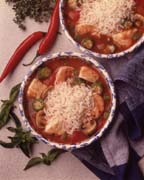
A big difference between Cajun and Creole jambalaya is tomatoes: the Creoles put them in, but not the Cajuns (no doubt because they did not grow them). The origin of this dish may be a derivation of the Spanish paella, but the word also could be from the French for ham (jambon) and an African-American slang term for rice (ya-ya). And, inevitably, the Cajuns' beloved crawfish have found their way into sushi and spring rolls and even into Oriental lunch buffet menus in Louisiana. There was no stopping those “mud bugs” after they got here!
Eat Well in New Orleans
For those attending the Institute of Food Technologists (IFT, Chicago) convention in New Orleans in 2005 and looking for good New Orleans restaurants, there is good news! It is difficult to find a bad New Orleans eatery. One of the best mixes of continental, Cajun and Creole cuisine can be found at Le Parvenu near the airport. The owner, chef Dennis Hutley, has blended well these three concepts on his upgraded bistro menu. There are as many neighborhood restaurants in New Orleans as there are coffee shops in Seattle, all offering good comfort food at low prices, with a great flair for seasoning and quantity. Residents of the Crescent City are fond of their food, and they are not hesitant about recommending their favorite restaurants. At breakfast, a favorite topic is: where are we having lunch? At lunch, the topic becomes: are you eating out tonight?If you are going to gain a few extra pounds, do it in New Orleans--you will enjoy it more!
Looking for a reprint of this article?
From high-res PDFs to custom plaques, order your copy today!