Kids' Snack Attack - May 2007
When
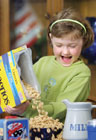
asked to define a snack, 56% of children between the ages of six and 11 define
a snack as “anything I eat between breakfast, lunch and dinner.”
The substantial influence children have in household spending is not a new concept, especially when it comes to food. A national survey commissioned by the Center for a New American Dream in 2002 found that 55% of kids say they are successful in getting their parents to give in to their demands. (The “nag factor”—kids use it, parents give in to it and manufacturers take advantage of it.)
Marketing to Kids
Children are the target of abundant marketing tactics. Character merchandising is perhaps one of the oldest forms of marketing to kids with animated characters such as Kellogg’s Tony the Tiger promoting products and brands. Character merchandising is an effective tool. In fact, research conducted for Mintel’s report “Character Merchandising—U.S., March 2006” found that 61% of parents indicate their child/children like to collect character merchandise, and nearly half of parents believe character-licensed products increase the willingness of the child to use a particular product.
Television advertising, especially on kid-oriented channels like Nickelodeon and Cartoon Network, remains a prime tool for selling food to kids. Statistics reveal that the average child watches more than 100 television commercials per day. Some $15 billion is spent annually on messages aimed at the youth market. Newer tactics include online strategies, allowing suppliers to hone in on certain age groups and genders. One kids’ snacking market example is found on Nestlé’s site, www.kids.icecream.com, which offers games to engage children for long periods of time, exposing them to key brands and establishing brand identity.
There is much debate regarding whether kids should be the recipients of such marketing tactics. In fact, a task force of the American Psychological Association has recommended restrictions on advertising that targets children under the age of eight, based on research showing that children under this age are unable to critically comprehend televised advertising messages and are prone to accept advertisers’ messages as truthful, accurate and unbiased.
Snack food manufacturers are taking some responsibility in marketing to children by channeling resources and promotions into education and programs to counteract the rising obesity rates in the U.S. For example, the General Mills Foundation invested more than $4 million in youth and health and nutritional programs. In 2005, Kraft launched its “Sensible Solutions” labeling program where “better-for-you” foods are highlighted, as did PepsiCo with its “Smart Spot” program.
An
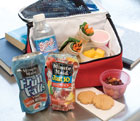
Indianapolis-based dietitian has opted to define the PACK lunch. The PACK guide
which Kim Galeaz promotes includes Protein, All fruits and vegetables,
Carbohydrates and calcium, and Kid-friendly beverages.
Trends and Innovation
Manufacturers need to do more than implement and promote health-awareness programs. Products need to provide a solid nutritional profile that parents will value and children will enjoy eating. Studies like the “National Institute of Health’s Report on America’s Children 2003” brought to attention foods thought to contribute to childhood obesity (especially those high in fat and sugar), and manufacturers were forced to re-evaluate not only their marketing, but more importantly, their products’ nutritional attributes. The result has been a plethora of reformulations reducing sugar, eliminating trans fats and utilizing whole grains.Besides nutrition, product innovation is also driven by Americans’ need for convenience, which has catapulted single-serving snacks into the limelight. According to Simmons’ data, 99% of kids eat single-serving snacks. For parents, it offers a grab-and-go snack option to take in the car or throw in a school lunch. Additionally, parents can utilize these convenient packs as a way to foster a child’s growing independence by allowing them to get their own snack with the knowledge that the portion will be controlled. The influx of pre-sliced and pre-packaged fruits/veggies is modernizing produce so that it is as convenient as a bag of chips, allowing produce manufacturers to be more competitive in the kids’ snacking arena.
A growing trend is making snacks more meal-like rather than a simple snack. In fact, Mintel’s consumer research performed for “Kids’ Snacking—U.S., August 2006” reveals that 46% of kids surveyed indicate they eat snacks that include a single item and a drink other than water. This suggests the kids are partaking in a “mini-meal” as opposed to a simple snack. Most adult weight-loss programs promote consuming multiple smaller meals in lieu of three traditional square meals a day. The promotion of “mini-meals” as a habit to begin during childhood could be positive for the kids’ snacking market if manufacturers participate by promoting “better-for-you” foods in an effort to promote a healthy lifestyle. The numerous scientific studies illustrating the relationship between nutrition and cognitive performance show that memory function directly correlates with levels of blood glucose. Clearly, this is an opportunity for snack food manufacturers targeting kids.
Kids Classify Foods and Define “Snack”
Not only are snacks becoming more meal-like in terms of substance, but the definition of a snack is wide open to interpretation. To gauge kids’ perceptions of what they eat as a snack, Mintel asked them to categorize a selected list of foods as a snack, treat or both. The results indicate that children seem to have a general consensus on what foods are categorized as snacks or treats. For example, crackers topped the list of kids’ snack food and was among the least likely to be reported as a treat; conversely, foods like ice cream are thought of as treats, with few kids reporting them as a snack food. There is a rather large gray area in which 25% to 35% of children classified foods like pizza rolls, chips, fruit roll-ups or cookies as both snacks and treats.Progressing a bit further, Mintel asked kids to define a snack. Results show that 56% of children aged six to 11 define a snack as “anything I eat between breakfast, lunch and dinner,” while 40% say it is specifically something they eat after lunch, school or dinner. The difference between the two statements is subtle, but the result implies that snacking among kids is ubiquitous. Suppliers are keenly aware of marketing snack products to be consumed anytime. For example, the Smucker Company launched Jif To Go packaged in easy-to-open, disposable, single-serving cups and is promoted for consumption anytime, allowing its user to spread, dip or eat “as is.”
It's Snack Time!
Mintel’s consumer research found that decision making about snacks is split evenly between kids and parents. Half of the kids said they are allowed to snack whenever they are hungry, while the other half reported needing parental/caregiver permission. However, parents are more apt to cede control when it comes time to choose what type of snack is served, with 69% of kids choosing the snacks themselves most of the time. A precipitous difference was noted with regard to age, with parents choosing more for younger kids than older ones. Fully 68% of kids say they make healthy snack choices, and 33% say they try not to eat too many sweets. While these terms are subjective, it does reveal that kids are becoming increasingly health-aware. Regardless, 96% of kids know that their parents like to be aware of their snacking choices.Salty, Sweet, Savory and Nutritional—A Plethora of Snack Options
Based on “Simmons Kids’ Survey,” fall 2005, Mintel classified various types of foods kids eat as snacks into salty, sweet and nutritional. Potato chips have the strongest incidence for consumption by children aged six to 11 years old, with 96% eating the crisps, followed by popcorn products, crackers, corn/tortilla/snack chips, pretzels and snack mixes. The majority of salty snack innovations focused on portion control and portability; others sought to increase kid appeal by adding “playability.” In February 2006, Frito-Lay launched Baked! Cheetos Crunchy Cheese Flavored Snacks in a 20oz tub with carrying handles that included two stay-fresh packs, a poster and Color Wonder finger paints.Nearly all children surveyed report eating sweet snacks, especially cookies and ice cream. The increased attention and implementation of the FDA’s nutrition labeling for trans fats had a significant impact on this segment, as nearly all cakes, cookies, crackers, pies and other bakery items contain trans fat. Many suppliers began reformulating baked goods to lower trans fat content. Yet, a shift towards health-conscientious eating that focuses on moving away from white flour and sugar content also impacts this market. Manufacturers are successfully introducing sweet snacks made from multigrain cereal and utilizing 100-calorie packs as a way to offer portion control. In June 2006, Hershey launched Snacksters Chocolate Cookies following these formats.
Portion and calorie controlled packaging indeed assists salty and sweet snacks to obtain a healthier image, subsequently making the idea of a nutritional snack even more subjective. Unequivocally, fruits and veggies are healthy snacks. Kids’ favorite packaged foods like cereal, chewy granola, nuts and granola are also considered healthy. With 93% of kids surveyed eating some nutritional snacks, it seems children’s snacking habits could be pointed in the right direction towards combating the rising childhood obesity rates. However, perceptions of what is healthy still lack definition.
The “Simmons Kids’ Survey,” fall 2005, found fruit to be the leading healthy snack among kids surveyed (78%), followed by cereal (45%). In 2004, leading cereal manufacturers launched kid-friendly cereal varieties with sugar reductions. For example, Kellogg’s introduced a third less sugar varieties of Frosted Flakes and Froot Loops. General Mills utilized the whole-grain movement to its advantage by classifying all its cereals as either “good” or “excellent” sources of whole grain.
Mintel found that 50% of the kids surveyed report their favorite nutritional snack is in their home “most of the time,” and 35% say “some of the time.” Because snacks provide a substantial amount of a child’s food intake, parents make an effort to keep favorite snacks on hand. Breaking down kids’ frequency of consumption for nutritional snacks even further, Simmons’ data reveal that kids consume an average of eight nutritional snacks per month—an equivalent of two per week. This evidence would suggest that for other snacking occasions, kids are turning to salty, sweet or savory snacks that offer less nutritional value.
Savory snacks are more prominent as snacks evolve into the “mini-meal.” Product innovation in savory snack foods focuses on smaller versions of traditional kids’ favorites like single-serve pizzas or pizza/snack rolls. Although these savory mini-meals are growing in popularity among parents and kids alike, these snacks are not necessarily healthy choices. According to GNPD, in 2005 there were 134 frozen snacks introduced, yet only 12 had any one of a long list of healthy positioning claims. Further, of all 12 products, none clearly targeted young children.
The Kids' Snack Market—A Healthy Future
Kids will always be incessant snackers. As such, children hold an important role with snack food manufacturers both now and as future adult consumers. As the incidence of childhood obesity continues to escalate, parents need to command more control over kids’ snacking habits. While children do exert opinions and utilize the “nag” factor regarding snacks, parents ultimately decide what types of snack foods are available in their homes. It seems parents provide snack food options, but in general, children actually choose what they will eat.Meanwhile, snack food manufacturers are in the center of the childhood obesity controversy and are being held accountable for marketing tactics that target children. Mintel believes that snack food manufacturers that take an active approach in helping parents win the snack food battle by offering products that offer a solid nutritional profile and are delivered in an appropriate kid-portioned size with kid-friendly tastes will reap the most future gains.
This article contains information from the Mintel reports “Kids’ Snacking-U.S., August 2006” and “Character Merchandising-U.S., March 2006.” Please visit http://reports.mintel.com for more information or call Mintel at 312-932-0400.
Looking for a reprint of this article?
From high-res PDFs to custom plaques, order your copy today!