A Taste of Honey
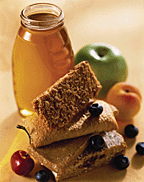
A study by the University of Illinois, Urbana-Champaign found that although honey may not serve as a major source of dietary antioxidants, it has the potential to play an important role in providing antioxidants in a palatable form. According to the study, “Due to the pleasing taste of honey, it may be more readily consumed by individuals reluctant to ingest appropriate quantities of plant-derived antioxidants in the form of fruits and vegetables.”
Honey's benefits upon the taste of fruits and vegetables were further explored in a University of Georgia study. “Honey has the ability to decrease the sourness of the product without contributing too many simple carbohydrates and masking the flavor of the fruits,” the study determined in examining honey's effect on the four basic tastes.
Researchers found honey enhanced sweetness intensity, particularly on lightly sweetened products. Bitterness intensity was decreased in bitter solutions. In fact, product developers may be able to use this property of honey to improve consumer acceptability of sweet and savory products and mask the bitterness of some otherwise desirable ingredients.
Researchers, however, believe this usage could extend beyond foods and into beverages. The University of Nebraska-Lincoln examined honey's effects upon beverage formulation.
Shelf-life studies revealed little change in beverage color, clarity, pH and percent soluble solids during six months of storage. While the amount of sedimentation increased in both beverages over time, the lemon-chamomile beverage had less sedimentation compared to the cranberry beverage. Both were microbiologically stable during storage. Sensory analysis revealed the lemon-chamomile and cranberry juice drinks were acceptable for 180 days, with the highest degree of acceptability at 90 days. In nonalcoholic beverages, honey proved an effective energy source and provided flavor, color and mouthfeel. This has led some to conclude that honey's use can extend into food and beverage items targeted at athletes.
“During the past three decades, carbohydrate 'sports gels' have become a popular means of providing energy to athletes,” said Dr. Richard Kreider of the University of Memphis Exercise and Sport Nutrition Laboratory, which conducted its own study into honey's effects on recuperation after workouts. “We found honey to be one of the most effective forms of carbohydrate gels to ingest just prior to exercise. This could translate into greater endurance during a workout or race.”
“Honey appears to be a carbohydrate source relatively mild in its effects upon blood sugar, compared to other carbohydrate sources,” added Dr. Kreider.
The study's results indicate honey is an effective and affordable alternative carbohydrate course for endurance athletes, particularly those with a preference for natural products. In the study, honey's performance equaled glucose's, the most common carbohydrate supplement.
National Honey Board
Write in 266
Looking for a reprint of this article?
From high-res PDFs to custom plaques, order your copy today!
 |
William Roberts is responsible for the consumer trends section in Prepared Foods, as well as the website news updates and e-newsletter. He served as the Senior Copy Editor at Elevator World. He holds a B.A. in English and a B.S. in Political Science from the University of Mobile.