Ingredients in Use: Soy Proteins
Soy Story
Whether due to its healthful benefits or its ability to solve a variety of formulation challenges, soy protein can be found in foods ranging from ice cream to burgers, from milk to nut products. Soybean-based ingredients in the form of soy protein concentrates, refined soy protein isolate or tofu can be used alone or mixed with other ingredients to create meat alternative products. Usually, the meat alternatives can be used in the same manner as the food it replaces.
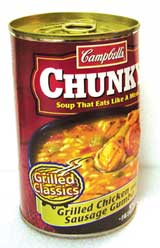
The nutritional value of soyfood products varies considerably. As a general rule, they are lower in fat, but there are exceptions. Meat alternatives made from soybeans serve as excellent sources of protein, iron and B vitamins. Boasting 10g of protein, the grilled chicken and sausage gumbo variety of Campbell Soup's (Camden, N.J.) Chunky soup lists soy protein isolate (SPI) among its ingredients. The most highly refined soy protein, SPI is the result of isolating soy protein from defatted soy flakes. Containing at least 90% protein, SPIs have the greatest amount of protein content of all soy ingredients. Furthermore, they serve as a highly digestible source of amino acids, regarded as the protein building blocks needed for proper human growth and maintenance.
Concentrated Efforts
With so many consumers regularly enjoying ready-to-eat (RTE) cereal, it serves as an effective delivery system for soy protein. Technical work with soy protein concentrates and cereals demonstrates how manufacturers can incorporate soy into the formulation to meet the FDA's requirements of 6.25g of soy protein per serving needed for the heart health claim. The form of soy protein concentrates selected depends largely upon the cereal manufacturing process, be it agglomeration to form clusters, batch cook to form flakes, or extrusion for forming flakes or expanded pieces. Some soy protein concentrates can be blended with other ingredients and then agglomerated to form clusters.Compatible with traditional batch pressure-cook processes for cereal, many textured soy protein concentrates can be added into a mixture of split or crushed grains cooked together. A low-pressure extruder then can be used to form the resulting dough into pellets, which are rolled into flakes.
Powdered soy protein concentrate can have a very fine texture. When mixed with water, a slurry is formed. Through the years, suppliers have produced increasingly mild, blandly flavored soy protein ingredients. Textured soy protein (TSP) concentrates generally have a fibrous texture and can be made into various sizes and shapes. Since the FDA approved the health claim linking soy protein and improved heart health in 1999, interest in the use of soy proteins has soared among all types of consumers, especially within the burgeoning vegetarian market.
Today's more sophisticated and demanding vegetarians demand meatless options with great taste and texture. TSPs serve to provide texture and mouthfeel in numerous meatless entrées, with versions appearing on the label as textured soy flour and textured soy protein concentrate.
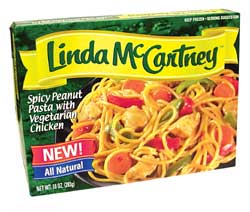
Textured soy flour is created by running defatted soy flour through an extrusion cooker, allowing for different forms and sizes. About 50% protein, soy flour also contains the dietary fiber and soluble carbohydrates from the soybean. Possessing a chewy texture in its hydrated form, it is used widely as a meat enhancer. However, rehydrated soy protein also makes its way into vegetarian meals as a meat alternative. One example is the spicy peanut pasta with vegetarian chicken in a variety of frozen meals from the Linda McCartney line of Ethnic Gourmet Foods (Framingham, Mass.).

Filling Time
Soybeans are an inexpensive meat enhancer. Several forms of soy proteins can be found in meat alternative products. Vegetarian patties and sausages, for example, may contain textured soy flour, textured soy protein concentrates and isolated soy proteins. For example, an isolated soy protein product can be responsible for the textural characteristics of frankfurter-like products.In addition to vegetarians, soy also may be helpful for dieters, serving as a source of low-fat, high-quality, plant-based protein that may help one eat less often and decrease hunger because, as a protein, it helps with satiety (the feeling of being full). High-quality protein also helps the consumer to maintain muscle mass during weight loss. Merely adding soy proteins to the diet has shown tremendous health benefits, as published in hundreds of research journals.
The possible health benefits of soy proteins is illustrated in Asian cultures, where the typical diet contains 10 to 25 times the amount of soy as compared to Western diets. Not coincidentally, believe many researchers, these cultures have lower incidences of menopausal symptoms, osteoporosis, cardiovascular disease, and prostate, breast and uterine cancer.
Considering the numerous health benefits, it should come as no surprise that protein has begun to permeate the most convenient of food items, the cereal bar. GeniSoy's (Fairfield, Calif.) GeniSoy Soy Protein nutrition bars, for example, boast 14g of protein and list soy protein isolate first on the ingredients legend. It also claims to have 25% of the daily value of a pair of B vitamins (6 and 12) plus the same daily value of iron. In addition, each variety contains 20 vitamins and minerals.
Crunch Time
In nutrition bars and staples such as bread and cereal, soy protein and its isoflavones are attractive selling points. Considering soy isoflavones are generally heat-stable during processing, they are suitable for numerous foods, including extruded products. Among the soy proteins used in bars and cereals are soy flour, soy grits, textured soy protein, soy protein concentrate (powders and grits), textured soy protein concentrate and isolated soy protein. Some uses of soy protein concentrates and isolated soy proteins have seen these ingredients extruded with rice flour and other ingredients to produce high-protein rice crisps and cookie pieces for use in bars and cereals.
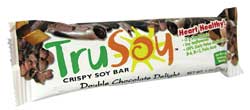
TruSoy crispy soy bar from Richardson Labs Inc. (Boca Raton, Fla.), for instance, has soy crisps first on its ingredients list, defining the crisps as made from SPI, tapioca starch and malt extract. SPI also is the second ingredient listed, no doubt helping to boost the bar's protein content to the 16g listed on the nutrition legend. Vitamins B6 and B12 also are amply represented, as the bar contains 100% of the daily value of each.

Make It Smooth
Numerous isolated soy proteins with a variety of viscosity profiles help provide varying degrees of consistency in finished beverages. For example, a soy shake possessing a smoothie-like consistency demands a high-viscosity protein. However, a high-protein shake with a milky consistency requires a low-viscosity product. In juice-based beverage applications, special stabilization is needed (pectin often serves as a stabilizer).Soy proteins do have a few drawbacks. Soy proteins cannot be used in a clear-based liquid beverage. In addition, some soy protein ingredients do impart some beany flavor, though advances are being made in this area. Typically, however, any of a variety of masking flavors can be used in the powdered soy proteins to cover the beany taste. Many ISPs are used in beverages, but suppliers caution developers to start with an ISP that has the proper functional characteristics of the particular beverage application. Furthermore, in liquid beverage applications, the soy protein must be properly hydrated to obtain the desired results.
In addition to the health benefits, soy protein in concentrate form and isolates are finding their way into more indulgent food products. Yogurts and smoothies, for example, are benefiting from the ingredients' functional attributes and abundant healthful properties. Hansen's Natural (Corona, Calif.) Protein Smoothies list soy concentrates, as well as fruit juice concentrates, natural flavors, vitamins A, C and E, plus beta-carotene. Despite the presence of soy protein, these smoothies claim a relatively light 3g of protein (2.7g of that being soy protein).

Leaning to the Diet
Chef America (Englewood, Col.) added hydrolyzed soy protein to its Cheeseburger flavor of Lean Pockets, although it comprised a portion of the seasoning within the “water and binder product.” Still, the product boasts a considerable 13g of protein, although it also claims 7g of fat, 42g of carbohydrates and 670mg of sodium.
At this year's edition of the Institute of Food Technologists' (IFT) show, J.W. Anderson, with the Metabolic Research Group at the University of Kentucky (Lexington, Ken.), investigated soy protein's role in obesity management and risk reduction. Anderson provided an overview of the research supporting the use of soy protein in weight management diets, while also addressing the benefits of soy protein consumption in managing and preventing chronic diseases commonly associated with obesity. While effectively promoting weight loss in individuals on energy-restricted diets, soy protein also has been found to reduce cardiovascular disease by “improving serum lipoprotein values, enhancing blood vessel reactivity, decreasing inflammatory responses, antioxidant action and decreasing blood clotting.” Already established through research as a heart healthy food, soy protein also may provide cognitive benefits. And animal studies suggest soy protein may help with diabetes by influencing insulin activity in the body, specifically insulin resistance, and favorably altering glycemic control.
Website Resources
www.soybean.org - Soy Protein Partnerswww.soyfoods.org - Soyfoods Association of America
www.nal.usda.gov/fnic/foodcomp/Data/isoflav/isoflav.html - Soy Isoflavone Database
Some of the information in this article has been derived from Mintel International's Global New Products Database, www.gnpd.com, 312-932-0400. For more information on the GNPD, email kthackston@mintel.com

Sidebar: Going Global
In Australia, Sara Lee (Chicago) has launched Light Snack Quiche Lorraine, retailing for roughly $3.91. Said to contain 34% less fat with no additional colors or flavors, these include such varieties as Creamy Light Ice Cream, Tasty Light Chocolate Cake and Fruity Light Pies. Soy protein appears in the Quiche Lorraine variety's ham ingredient, which also boasts water, potato starch, salt, mineral salt, dextrose, antioxidant, natural smoke flavor, hydrolyzed vegetable protein and a preservative.

Looking for a reprint of this article?
From high-res PDFs to custom plaques, order your copy today!
 |
William Roberts is responsible for the consumer trends section in Prepared Foods, as well as the website news updates and e-newsletter. He served as the Senior Copy Editor at Elevator World. He holds a B.A. in English and a B.S. in Political Science from the University of Mobile.