Prepared Foods logo
search
cart
facebook twitter linkedin youtube
  • Sign In
  • Create Account
  • Sign Out
  • My Account
Prepared Foods logo
  • TRENDS
    • Prepared Foods The Year Ahead
    • Innovation Month
    • *Sustainability*
  • PRODUCTS
    • Bakery
    • Beverages
    • Breakfast, Cereals & Bars
    • Candy
    • Cannabis
    • Dairy
    • Meals & Sides
    • Meat, Poultry & Seafood
    • Sauces & Marinades
    • Snacks & Appetizers
    • Soups
  • INGREDIENTS
    • Antioxidants & Nutritionals
    • Colorings
    • Dietary Fiber
    • Emulsifiers, Fat & Oils
    • Flavors, Seasonings, Spices
    • Flours, Grains, & Pasta
    • Fruits, Vegetables and Nuts
    • Gums & Starches
    • Phosphates & Acidulants
    • *Proteins*
    • Sweeteners
  • FORMULATION
    • Allergens & Intolerance
    • Authentic & Ethnic
    • Cost Reduction
    • Fat Reduction
    • Gluten Free
    • *Immunity*
    • *Natural / Organic*
    • *Plant Based & Vegetarian*
    • R&D Lab Tech / QA-QC / Food Safety
    • Shelf Stability
    • *Sugar Reduction*
  • BETTER FOR YOU
    • Functional New Products
    • Functional Ingredients
    • Functional Benefits
  • FOOD MASTER
  • MEDIA
    • Podcasts
    • Videos
    • Infographics
    • First Person Q&A
    • Favorite Products Poll
    • Play With Your Food Game
    • Webinars
  • STORE
  • EVENTS
    • Spirit of Innovation Awards
    • Industry Events
  • EMAG
    • eMagazine
    • Archive Issues
    • Advertise
  • SIGN UP!

Maximizing Acidifier Flavor Effects
December 10, 2003
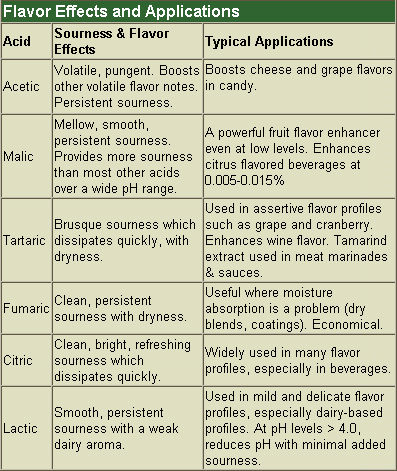
Acidic ingredients can contribute more than just sourness. They also have unique sensory effects that are used in the creation of flavorful food and beverage products.

Acids, in themselves, affect sensory systems in four different ways. In the mouth, they impact taste receptor cells, which detect sourness, and the trigeminal system, which is sensitive to chemical irritation. Examples of the latter include extremely sour candies or the dryness or astringency from tannins and certain acids.

In the nasal cavity, aromas are detected by olfactory receptor cells while volatile chemical irritants, such as those associated with horseradish, affect the nasal trigeminal system. All acids have an oral impact but only some have a nasal impact.

The amount of sourness is determined by which acid is used, its concentration and the pH. At any given pH, an equilibrium is reached between an acid's undissociated—or protonated—forms (e.g. lactic acid) and dissociated—or ionized—forms (e.g. lactate). As pH decreases, levels of the sour-tasting, undissociated forms substantially increase (completely dissociated acids are not sour).

Because the amount of an acid's undissociated forms at different pH levels can be calculated, so can the relative sourness between acids at different pH levels be estimated. For example, at or above pH 4.0, lactic acid is less sour than most acids; below 4.0, it is more sour than citric acid.

These sourness models are helpful in choosing acids for a desired perception of sourness at a specific pH. However, other factors also are important. For example, products that are mostly water, such as beverages, are very sensitive to changes in the acidic ingredients. Products containing higher amounts of hydrocolloids and fat are less sensitive.

A mutual masking between sweetness and sourness also exists. Some pigments, flavors, and gelling agents are very sensitive to pH—so a narrow pH range is needed for consistency. This is achieved through the use of buffers, which are partially neutralized acids that resist changes in pH.

In trying to obtain a target pH—while still achieving a desired degree of sourness—various tactics can be taken.

Maintaining sourness while raising pH.
To increase the pH without reducing sourness, select buffer salts and/or acids with maximum sourness at the target pH. For example, at pH levels between 4.0-5.0, add sodium or potassium citrate to raise pH and replace part of the citric acid with malic acid to maintain sourness.

Increasing sourness while maintaining pH.
Increase the concentration of the buffer salt and the acidic ingredient, but maintain the same ratio. The pH remains close to the same, but sourness increases because there is more undissociated acid present. For example, if a formulation has a pH of 4.4 with 0.06% sodium citrate and 0.13% lemon juice concentrate, increase the sodium citrate and lemon juice concentrate levels to 0.09% and 0.195%, respectively.

Lowering pH with minimal added sourness.
At target pH levels above 4.0, use lactic acid to lower the pH with minimal added sourness. At pH levels below 4.0, use phosphoric and citric acids instead. Phosphoric acid is much less sour than citric acid but is more difficult to handle. There are patents covering the use of phosphoric acid in salad dressings and the use of glucono-delta-lactone (GDL) to lower pH without increasing sourness.

Technical contact: Daniel Sortwell, 336-712-9804, drs@usa.net
Sales contact: David Tapajna, 905-662-1127, dtapajna@yahoo.com
www.bartek.on.ca Bartek Ingredients Inc. WRITE IN 206

Share This Story

Looking for a reprint of this article?
From high-res PDFs to custom plaques, order your copy today!

Recommended Content

JOIN TODAY
to unlock your recommendations.

Already have an account? Sign In

  • Women in beverge isle

    Ingredient Demonization May Not Drive Consumer Behavior

    While tracking cultural conversations around demonized...
    Breaking News
    By: Prepared Foods Editorial Staff
  • Bubs Candy Packages

    Sweden’s Viral Candy Brand BUBS Lands in US Retail Nationwide

    TikTok videos of BUB's unique chewy-meets-marshmallow...
    Candy
    By: Prepared Foods Editorial Staff
  • Innovation Month Logo Orange

    Introducing Innovation Month: A Deep Dive into the Future of Food & Beverage

    The next wave of food innovation is here. Dive into the...
    2025 Food and Beverage Trends
    By: Prepared Foods Editorial Staff
Manage My Account
  • eMagazine Subscription
  • Newsletters
  • Manage My Preferences
  • Online Registration
  • Subscription Customer Service

More Videos

Popular Stories

General Mills US250 Packages

General Mills Launches 79 Limited-Edition Summer Products

Circana Pacesetters 2026

Circana Highlights 2025 CPG Pacesetters

Bushs Baked Beans LTO Flavors

Bush’s Beans Debuts Summer-Inspired Flavors

PF Webinar sponsored by FoodChain: Signals to Shelf: Turning Consumer Insight into Executable Innovation

Events

June 18, 2025

Master the Art of Plant-Based Dairy

ON DEMAND: Whether you're in R&D, formulation, or innovation, this session will provide enzyme-driven insights to improve your plant-based dairy portfolio.

June 25, 2025

Market in Motion: Active Nutrition

ON DEMAND: Once targeted at athletes, active nutrition products with benefits like energy, focus, hydration, and protein are now winning over everyday consumers seeking support for their busy lifestyles.

View All Submit An Event

Products

Recent Advances in Ready-to-Eat Food Technology

Recent Advances in Ready-to-Eat Food Technology

See More Products

CHECK OUT OUR NEW POWER TRENDS

Immunity Logo
Natural & Organic Logo
Plant Based Logo
Protein Logo
Sugar Reduction Logo Sustainability Logo

Related Articles

  • Maximizing a Baked Goods Matrix

    See More
  • Special Effects Chocolate

    See More
  • Huxleys gummies

    Huxleys launches effects-based products in California

    See More

Events

View AllSubmit An Event
  • November 19, 2025

    Reformulate With Confidence: Natural Solutions for Sodium Reduction and Savory Flavor Enhancement

    ON DEMAND: Whether you’re reformulating a classic or developing a new product line, this webinar offers real-world examples, technical guidance, and expert perspectives to help you meet evolving consumer demands for healthier, flavor-forward foods.
View AllSubmit An Event
×

Unlock the Future of Food and Beverage Innovation

Are you a leader in research & development? Stay ahead of the curve with Prepared Foods, the premier source of information and insights for today's trend leaders and taste-makers in food and beverage manufacturing.

JOIN TODAY
  • Resources
    • Advertise
    • Contact Us
    • Food Master
    • Store
    • Join
  • Sign Up Today
    • Create Account
    • eMagazine
    • Newsletters
    • Customer Service
    • Manage Preferences
  • Services
    • Marketing Services
    • Reprints
    • Market Research
    • List Rental
    • Survey/Respondent Access
  • Stay Connected
    • LinkedIn
    • Facebook
    • Instagram
    • YouTube
    • X (Twitter)
  • PRIVACY
    • PRIVACY POLICY
    • TERMS & CONDITIONS
    • DO NOT SELL MY PERSONAL INFORMATION
    • PRIVACY REQUEST
    • ACCESSIBILITY

Copyright ©2026. All Rights Reserved BNP Media, Inc. and BNP Media II, LLC.

Design, CMS, Hosting & Web Development :: ePublishing