Prepared Foods logo
search
cart
facebook twitter linkedin youtube
  • Sign In
  • Create Account
  • Sign Out
  • My Account
Prepared Foods logo
  • TRENDS
    • Prepared Foods The Year Ahead
    • Innovation Month
    • *Sustainability*
  • PRODUCTS
    • Bakery
    • Beverages
    • Breakfast, Cereals & Bars
    • Candy
    • Cannabis
    • Dairy
    • Meals & Sides
    • Meat, Poultry & Seafood
    • Sauces & Marinades
    • Snacks & Appetizers
    • Soups
  • INGREDIENTS
    • Antioxidants & Nutritionals
    • Colorings
    • Dietary Fiber
    • Emulsifiers, Fat & Oils
    • Flavors, Seasonings, Spices
    • Flours, Grains, & Pasta
    • Fruits, Vegetables and Nuts
    • Gums & Starches
    • Phosphates & Acidulants
    • *Proteins*
    • Sweeteners
  • FORMULATION
    • Allergens & Intolerance
    • Authentic & Ethnic
    • Cost Reduction
    • Fat Reduction
    • Gluten Free
    • *Immunity*
    • *Natural / Organic*
    • *Plant Based & Vegetarian*
    • R&D Lab Tech / QA-QC / Food Safety
    • Shelf Stability
    • *Sugar Reduction*
  • BETTER FOR YOU
    • Functional New Products
    • Functional Ingredients
    • Functional Benefits
  • FOOD MASTER
  • MEDIA
    • Podcasts
    • Videos
    • Infographics
    • Play With Your Food Game
    • Webinars
  • EVENTS
    • Spirit of Innovation Awards
    • Industry Events
  • MORE
    • Favorite Products Poll
    • First Person Q&A
    • Sponsor Insights
    • Store
  • EMAG
    • eMagazine
    • Archive Issues
    • Advertise
  • SIGN UP!

Formulation Challenge: Boosting Bread's Value

By Laura A. Brandt
December 2, 2003
Fats, oils and emulsifiers play an important role in baked goods. For example, in soy-based breads, soy flour absorbs water to form a gel, making the loaves quite dense. Emulsifiers help open up the bread texture for less-dense loaves, with greater volume. In addition, emulsifiers improve dough handling and help extend bread's shelf life.


Emulsifiers

By using a surfactant, such as an emulsifier, one can create an emulsion of two or more incompatible substances. A typical emulsion is a dispersion of small droplets of one immiscible liquid within another. Emulsifiers keep the droplets from coalescing. These ingredients not only offer emulsification, but also starch complexing, protein strengthening and aeration in baked goods.

Emulsifiers are used in bread to extend shelf life by slowing down the staling process. Bread tastes and feels stale when it starts to taste like cardboard, and feels dry and hard. In the laboratory, staleness can be measured by the crumb's resistance to compression, with an instrument such as the Instron Universal Testing Machine.

Emulsifiers used in breads include mono- and di-glycerides, various forms of lecithin, diacetyl tartrate ester of monoglyceride (DATEM), and sodium stearoyl lactylate (SSL). Most bakeries use a blend of these functional ingredients.
According to research studies, staling is not related to moisture loss from bread. While days old bread gives a drier mouthfeel, it has the same moisture level as fresh bread.

Rather than producing an initially softer crumb, as previously believed, emulsifiers interfere with the recrystallization (or retrogradation) of amylose, which retards the firming rate. The fatty acid-end of emulsifiers forms a complex with gelatinized starch to slow down starch recrystallization and the staling process in bread. (See chart on page 42.)
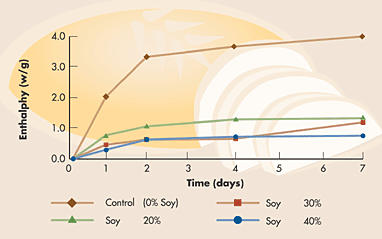
The rate of staling in wheat bread can be quantified by the amount of starch molecule (amylopectin) recrystallization, as measured by DSC (differential scanning calorimetry). Adding soy decreases recrystallization and, thus, retards staling, as compared to a control without soy.
Emulsifiers used in breads include mono- and di-glycerides, various forms of lecithin, diacetyl tartrate ester of monoglyceride (DATEM), and sodium stearoyl lactylate (SSL). Emulsifiers have different functions in bread, e.g. lecithin behaves as a wetting agent, while DATEM and SSL act as dough strengtheners. Most bakeries use a blend of these functional ingredients.

Lecithin

Lecithin, a primary emulsifier in egg yolks, also can be derived from rice and other grains. Soy-based lecithin, which contains phospholipids, is a by-product from the refining of crude soybean oil. The four main components of soy lecithin include phosphatidylcholine, phosphatidylethanolamine, phosphatidylinositol, and phosphatidic acid. Soy-based lecithin has a more healthful image than some other emulsifiers.

With lecithin's hydrophobic and hydrophilic portions, it can simultaneously interact with both oil and water, making it an effective emulsifier. In addition, lecithin aids in machinability and shortening dispersion of baked goods. Various types of lecithin are available to bakers including fluid, deoiled (hydrophilic), chemically-modified (acetylated/hydroxylated), enzyme-modified (EM) and powdered versions of these.

Considerations for selecting lecithin are specific benefits, labeling requirements and handling procedures. Fluid lecithin is a viscous, syrupy, amber-colored liquid. Bakers prefer powdered lecithin. It is easy to incorporate with dry ingredients and is convenient to add to dry mixes.

Powdered, deoiled lecithin, commonly used in breads, has less flavor than fluid lecithin, is higher in phospholipid content, and is water dispersible. Standard fluid lecithin contains about 30% soybean oil, with deoiled lecithin containing 2% or less, says Karen Allen-Seabolt, associate scientist with Central Soya Co., Inc., Lecithin Group, Fort Wayne, Ind. Usage level is about 0.5 to 1.0% on a flour weight basis.

“We have different forms of lecithin to help increase volume and dough strengthening, and to extend shelf life,” says Seabolt. “Deoiled, non-modified lecithin helps improve crumb structure and volume, but it doesn't help as much as enzyme—modified lecithin with shelf life for yeast-raised products.”

Deoiled lecithin is more concentrated in phospholipids—the active, functional component of lecithin—than fluid forms, according to Bruce Sebree, Ph.D., manager of Emulsifier and Texturant Technology, ADM Research, Decatur, Ill. In most formulations, deoiled lecithin can replace standard fluid at two-thirds usage rate, he adds. EM lecithin performs similarly to monoglycerides because it will form a complex with starch more readily.

“In enzyme-modified lecithin, the middle-position fatty acid is removed from the phospholipid with a phospholipase enzyme,” says Seabolt. “It is replaced with a hydroxyl group, making the molecule more polar, which increases its ability to complex with starch. EM lecithin is used mainly for yeast-raised baked goods to extend shelf life, but it also improves volume with its ability to act as a dough strengthening agent.”

EM lecithin can replace mono-glycerides. Its use in bread is becoming more popular with bakeries today, adds Seabolt.
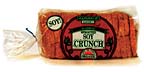

Alvarado Street Bakery uses several soy-based ingredients in its Sprouted Soy Crunch Bread, including: Organically-grown sprouted soybeans, toasted soy nuts, organically-grown whole soy flour, soy-based lecithin, as well as unsulphured molasses and organically-grown sprouted whole wheat. The bread is frozen, then shipped to mainstream supermarkets and health food stores coast to coast.

Sidebar: OSU Researchers Formulate Tasty Soy Bread

Rather than relying on a nutritional bar or a beverage, researchers at Ohio State University (OSU) are hoping that consumers will consider an everyday food to get soy into their diets—bread.

One large slice or two slices (50g) of the bread contains 6.25g of soy protein per serving, which meets the soy protein health claim criteria.

“I didn't start looking for health claims—I became interested in adding soy to bread formulations and comparing wheat bread and soy breads because staling seemed to be retarded with the addition of soy flour to wheat flour,” says Yael Vodovotz, assistant professor of food science at Ohio State University and co-author of the book, Bread Staling. (CRC Press, 2000).

Vodovotz found adding soy to bread decreases amylopectin recrystallization significantly, increasing the soy bread's shelf life.

The bread contains flour made from hard red wheat and two soy-based ingredients—soy flour and soymilk powder. While loaf volume decreases with an increase in soy flour, soymilk helps increase the loaf volume and has a positive flavor impact, says Vodovotz. Adding mono- and di-glycerides—as well as some fat—helps increase the loaf volume by lubricating the dough system and increasing the flexibility of the intercellular structure. A dough strengthener, L-cysteine, boosts internal structure.

A consumer acceptability study by Cory Ballard, an OSU undergraduate and senior food technologist for Chef-Con, Delaware, Ohio, found that 70% of those who participated in in-store sensory tests preferred the flavor of soy bread to that of red wheat bread. “Kids really liked the soy bread because it's sweet,” says Ballard.

In another study A.S. Colakoglu, an OSU student, investigated “The effect of soy on the thermal and mechanical properties of bread during storage.” Differential Scanning Calorimeter (DSC) studies showed that the addition of soy flour (20%-40% substitution) to wheat flour decreased the amount of “freezable” water and amylopectin recrystallization, which can be interpreted to say that adding soy flour retards staling.

OSU is licensing the formula to bakeries for sale in mainstream supermarkets. Researchers at the OSU medical school want to test the bread's cancer-control potential.

Links

  • PF article overview on science of emulsifiers and processing
  • AACC abstract on consumer acceptability of soy bread
  • Press release on heart-healthy soy bread
  • French Meadow Bakery, Minneapolis, Minn.
  • Alvarado Street Bakery, Rohnert Park, Calif.
  • PF article on soyfood
  • AACC abstract on soy's effect on bread properties during storage

Share This Story

Looking for a reprint of this article?
From high-res PDFs to custom plaques, order your copy today!

Field Technical Editor

Recommended Content

JOIN TODAY
to unlock your recommendations.

Already have an account? Sign In

  • Women in beverge isle

    Ingredient Demonization May Not Drive Consumer Behavior

    While tracking cultural conversations around demonized...
    Ingredients
    By: Prepared Foods Editorial Staff
  • Bubs Candy Packages

    Sweden’s Viral Candy Brand BUBS Lands in US Retail Nationwide

    TikTok videos of BUB's unique chewy-meets-marshmallow...
    Product of the Day
    By: Prepared Foods Editorial Staff
  • Innovation Month Logo Orange

    Introducing Innovation Month: A Deep Dive into the Future of Food & Beverage

    The next wave of food innovation is here. Dive into the...
    Breaking News
    By: Prepared Foods Editorial Staff
Manage My Account
  • eMagazine Subscription
  • Newsletters
  • Manage My Preferences
  • Online Registration
  • Subscription Customer Service

More Videos

Sponsored Content

Sponsored Content is a special paid section where industry companies provide high quality, objective, non-commercial content around topics of interest to the Prepared Foods audience. All Sponsored Content is supplied by the advertising company and any opinions expressed in this article are those of the author and not necessarily reflect the views of Prepared Foods or its parent company, BNP Media. Interested in participating in our Sponsored Content section? Contact your local rep!

close
  •  A close-up of a fruit branch on a cherry tree.
    Sponsored byU.S. Tart Cherries

    When Provenance Meets Performance: The Case for U.S.-Grown Montmorency Tart Cherries

Popular Stories

Overhead view of Asian-inspired rice bowls, bao buns, shrimp, chicken, fresh vegetables, and chopsticks arranged on a dark wooden table.

UPFs: The Culinary Science View

Buckwalter OceanSpray CEO

Ocean Spray Names Abigail Buckwalter CEO

A column chart made of sugar cubes with a blue background.

Sugar, Salt Reduction Drives New Formulation Strategies

PF Webinar sponsored by FoodChain: Signals to Shelf: Turning Consumer Insight into Executable Innovation

Events

June 18, 2025

Master the Art of Plant-Based Dairy

ON DEMAND: Whether you're in R&D, formulation, or innovation, this session will provide enzyme-driven insights to improve your plant-based dairy portfolio.

July 22, 2025

Boost Flavour and Functionality in Plant-Based Beverages With Bio-Based Solutions

ON DEMAND: Demand for plant-based beverages is rising, driven by health, environmental, and dietary trends. Yet, challenges around taste, texture, stability, and nutrition remain.

View All Submit An Event

Products

Recent Advances in Ready-to-Eat Food Technology

Recent Advances in Ready-to-Eat Food Technology

See More Products

CHECK OUT OUR NEW POWER TRENDS

Immunity Logo
Natural & Organic Logo
Plant Based Logo
Protein Logo
Sugar Reduction Logo Sustainability Logo

Related Articles

  • Formulation Challenge: Savory Flavors Heat Up Stews

    See More
  • Formulation Challenge - Ethnic Desserts: Creaciones Dulces

    See More
  • FORMULATION CHALLENGE: CONFECTIONERY - A STICKY Situation

    See More

Related Products

See More Products
  • The 10 Principles of Food Industry Sustainabilty Cover

    The 10 Principles of Food Industry Sustainability - EBOOK

  • The 10 Principles of Food Industry Sustainabilty Cover

    The 10 Principles of Food Industry Sustainability

See More Products
×

Unlock the Future of Food and Beverage Innovation

Are you a leader in research & development? Stay ahead of the curve with Prepared Foods, the premier source of information and insights for today's trend leaders and taste-makers in food and beverage manufacturing.

JOIN TODAY
  • Resources
    • Advertise
    • Contact Us
    • Food Master
    • Store
    • Join
  • Sign Up Today
    • Create Account
    • eMagazine
    • Newsletters
    • Customer Service
    • Manage Preferences
  • Services
    • Marketing Services
    • Reprints
    • Market Research
    • List Rental
    • Survey/Respondent Access
  • Stay Connected
    • LinkedIn
    • Facebook
    • Instagram
    • YouTube
    • X (Twitter)
  • PRIVACY
    • PRIVACY POLICY
    • TERMS & CONDITIONS
    • DO NOT SELL MY PERSONAL INFORMATION
    • PRIVACY REQUEST
    • ACCESSIBILITY

Copyright ©2026. All Rights Reserved BNP Media, Inc. and BNP Media II, LLC.

Design, CMS, Hosting & Web Development :: ePublishing