Marinades 'Meat' Challenges
A marinade generally refers to a seasoned liquid in which meat, fish and poultry are soaked to become tenderized and/or absorb flavor. A marinating solution can be as simple as salt, phosphates and water, or more complex with flavors, seasonings, starches, vegetable or dairy proteins, acids, antimicrobials and antioxidants. Today's food manufacturers marinate meat using equipment such as injectors, tumblers and massagers.
In order to formulate a successful marinade, product developers should start with a gold standard, says John Randazzi, vice president of flavor development for a flavor base supplier. "Trial and error won't get you very far. The R&D group should agree on a target."
Processors can profit from value-added marinated products. However, they face challenges in developing meat marination systems that result in eye appealing, flavorful, juicy products. Today's food processors need both equipment know-how and knowledge of ingredient functionality to create successful marinated products.
Keeping in Juices
Actomyosin is muscle protein that forms from actin and myosin when muscle goes into rigor mortis. The prevention of actomyosin formation occurs in the presence of salts and phosphates, which increase the water-holding capacity (WHC) of the meat. The tissue fibers swell because of their uptake of marinade resulting in decreased cooking loss and increased juiciness and tenderness of the meat.Mixing, tumbling and massaging of meat at low temperatures facilitates tenderization through disintegration of the muscle fiber sheath and stretching of the myofibrils. The type of ingredients added also affects tenderization.
One of the keys to creating a functional marination system includes adding ingredients that promote the capability of muscle to bind water such as salt and phosphates, and those that actually bind water themselves such as soluble proteins and starches. All of the ingredients should be dispersed in ambient temperature water for proper dissolution. Marination and processing alters protein structures to yield tender, juicier meat after cooking.
Salt
Common salt--sodium chloride--solubilizes proteins to increase water-holding capacity. Although salt is part of traditional marination systems, salt levels in meat products are decreasing due to consumer concerns.Reduced salt levels in foods impact marination formulations, says Rick Hull, vice president of World Technology Ingredients Inc., Kingston, N.Y.
"If you put the traditional levels of 1.5 to 2% salt in a turkey breast today, people will tell you it's too salty. We are marinating more products with lower salt levels that don't have the ionic strength necessary to provide the water-holding capacity. This results in increased purge and issues with spoilage and shelf life. We are investigating ways to improve ionic strength without impacting sensory attributes."
Ionic strength is a key factor in marinade retention, says Romeo Toledo, Ph.D., food science professor, University of Georgia in Athens. "Ionic strength is dependent on the molar concentration of the various ions in solution and their charges. It impacts the dissociation of molecules. Protein solubility is a function of the amount of ions in solution," he notes.
Ingredients that are highly ionized dissociate into the component ions, increasing the ionic strength with relatively low concentration. Adding various ionic components such as salts of phosphates, diacetates, and organic acids can boost the total ionic strength and help solve problems with purge while maintaining low levels of sodium chloride.
Phosphates
Manufacturers use different phosphates to help retain marinade in meats. Choice of phosphate or phosphate blend depends upon the application and processing.Formulators commonly use salt and phosphates for a synergistic effect on moisture and flavor retention. While the USDA does not restrict salt concentration, the agency limits phosphates to 0.5% in finished products.
Phosphates vary in their solubility and effect on pH. While diphosphates may be somewhat more difficult to solubilize, they react with the muscle enzymes quickly to help hold water in the system.
"Phosphates can be best solubilized by dissolving them in room temperature water," says Toledo. "Tetrasodium pyrophosphate tends to have low solubility, while potassium salts are a little more soluble."
Pyrophosphate promotes myofibril swelling and myosin extraction. "Potassium pyrophosphate is a more soluble form of diphosphate," says Hull. "During rigor mortis ATP breaks down into adenosine diphosphate (ADP) plus monophosphate. Diphosphates react in the muscle to facilitate water-holding capacity. All phosphates must break down to diphosphate before they are biologically active in the muscle to promote marinade retention and water binding."
Sodium tripolyphosphate (STPP), a common ingredient in marination blends, breaks down into diphosphate slowly, says Toledo. Flavor-wise, the addition of too much phosphate can make for a soapy-tasting marinade. Others may perceive a dry mouthfeel with phosphates, especially with tripolyphosphate, says Toledo.
Flavor Tools
Flavor ingredients for marinades can include flavors, oleoresins, spices, hydrolyzed vegetable proteins (HVPs), and yeast extracts. In injected marinades, the solutions are generally colorless to avoid streaking the meat. Particulates add surface visual appeal via rubs and glazes, but would not be used in injection systems where the diameter of the needles varies from three to five millimeters.It is important to understand the heat process that the marinade is going to be subjected to so the flavor system can be developed to be the most stable and cost effective. Consumer cooking instructions are also a key factor. As the cooking temperature increases, the flavor is more susceptible to degradation. Encapsulated flavors can help boost flavor impact.
For more of a complete flavor system, food processors can also use prepared bases to flavor marinades. Bases come in a variety of flavors such as prime rib, roasted tomato, or mirepoix--a blend of onions, carrots and celery commonly used by chefs. Generally, about one to three percent base makes up an injection marinade.
"A base is a type of flavor concentrate in paste form," says Randazzi. "Bases contain a large portion of real meat blended with other flavoring tools. While flavors may give you a portion of the total flavor profile, a base will give you the entire flavor system for a relatively low cost." By cooking and concentrating real meat and vegetables, bases can provide a homestyle taste.
High Acid Marinades
Popular ethnic cuisines such as Latino, Asian, and Caribbean incorporate a variety of flavors, including citrus types. Although citrus flavors are gaining in popularity, they are more difficult to incorporate into a marinade system. Often the flavor profile turns out candy-like rather than a true citrus flavor with tartness. When the pH of a marinade is lowered too much, meat texture suffers. Typically, marinades that are highly acidic (pH below 5.0) can denature proteins, causing the meat to become too soft.One supplier has solved both textural and flavor problems associated with highly acidic systems. Its line of high-acid marinades includes lemon, lime, and orange flavor with blends of lemon pepper, orange coriander, lemon herb and cilantro lime.
"The acids in a marinade cause a rapid unfolding of the meat proteins leading to their denaturation," says Joseph Formanek, Ph.D., research scientist at the ingredient supplier.
"When you cook meat in which the proteins have been denatured, the resulting mushy texture allows for moisture release, resulting in tough, chewy meat." The marinade system compensates for the acid effects.
Flavor Trends
While lemon pepper and teriyaki are standard marinades, others are emerging. "We see Nuevo Latino as an upcoming trend," says Catherine Terry, marketing manager for an ingredient supplier. "Flavor profiles such as citrus, chili peppers, heat, cilantro, fennel, and fresh herbs are key for Nuevo Latino products."Another supplier has executed a "Marinade of the Month" program, sending finished product to customers and highlighting different seasoning/marination systems.
One of the big hits from this program includes Teriyaki Pineapple Chicken, a combination of Asian and Caribbean flavors prepared with a subtle black tea marinade, with hints of ginger, garlic and pineapple.
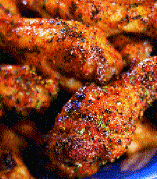
"Trends include fruity-sweet combined with heat," says Clare Moran, applications scientist for the ingredients supplier. "Others include cool and spicy-- the hot and spicy fruit glaze on the outside of our Cherry Habanero wings is balanced by the cool coconut cream cheese marinade on the inside. Other popular items include buffalo-style flavors and Asian marinades, with Cajun still in the running."
"Suppliers need to know what the product goes through in terms of processing methods, label restrictions, price, reconstitution rate, amount of pick up of the solution by the meat and expected yields," says Marie Eaton, project manager. "With this information, we can provide a customized system to meet individual needs."
Pork Goes Upscale
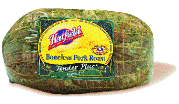
Last year, Hatfield Quality Meats, Hatfield, Pa., introduced its line of Hatfield® Marinated Fresh Pork, complete with a meat sensor to ensure proper cooking. The line of marinated tenderloin filets, boneless chops, and sirloin roast come in a variety of flavors that include Italian, Garlic & Onion, Garden Herb, Southwestern, Honey Mustard, Oven Roasted, Peppercorn, and Teriyaki.All of the items contain a tenderizing solution that includes water, salt, sodium phosphate and lemon juice solids. "We inject a 10% solution then add a dry topical seasoning on top of the meat that is then massaged. Then the products are vacuum packaged," says Jeff Bohmueller, Hatfield's Fresh Pork Product Manager.
Hatfield was the first to include a Cook'd Right Instant Meat Sensor in pork chops and tenderloins, says Bohmueller. The company provides pop-up timers in the roasts. "The Cook'd Right sensor is specifically designed for thinner cuts of meat where a pop-up timer cannot be used," he says. The meat has reached a safe 160°F when the small pen-like disposable sensor turns bright orange after being inserted into the meat for 10 seconds and pulled out.
"We credit our product success to knowing our consumers and offering convenient cuts and cooking instructions," says Bohmueller.
Looking for a reprint of this article?
From high-res PDFs to custom plaques, order your copy today!


