Imitating with Allergen-Free Formulations
Prepared Foods’ R&D Application Seminars speakers discuss the challenges and opportunities in formulating for the gluten free- and vegetarian-inclined diets
SOURCE: Copyright: Shubhashish5
There has been significant collaboration with food product research organizations to evaluate cooking pulse flours in a range of bakery applications.
SOURCE: Copyright: aluxum
Modified Cellulose Ingredients
Cellulose is sourced from wood and modified to render the water-soluble derivatives, methylcellulose (MC), hydroxypropyl methycellulose (HPMC) and hydroxypropyl cellulose (HPC). These are specialty stabilizers used to promote foam in non-dairy whipped toppings; to texturize veggie burgers; provide structure in gluten-free bread; and control fat uptake in fried foods.
Modified cellulose is cold-water soluble and hot-water insoluble with hydrophilic and hydrophobic sections. Used as a viscosifier, it is non-ionic with low surface tension. MC and HPMC exhibit thermal gelation and film formation, providing benefits in free-from and special diets (i.e., gluten-free).
“A survey of Americans found that of the gluten-free population, 8% say they have a gluten sensitivity, 10% has a family member with gluten sensitivity, 19% are gluten-free for digestive health, 26% consider gluten-free a healthier option and 35% give no reason,” discussed Jo Ann Popielarski, MS, RD, staff scientist, Nutrition Specialties, Ashland Inc.
As a refresher, she added that when developing gluten-free products, gluten is made of the two proteins—glutenin and gliadin—each with different functions needing replacement. Glutenin functions for elasticity and strength, while gliadin provides viscoelasticity and gas-holding properties. These properties result in ability of the dough to stretch and hold its shape; to rise and maintain volume with low density; and to open cell structure.
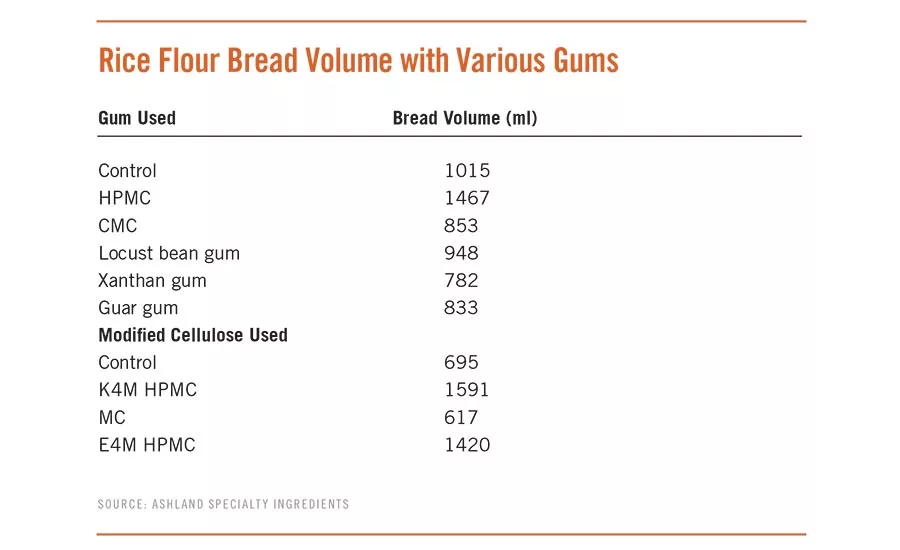
When developing gluten-free bread, HPMC is the preferred hydrocolloid due to its thermal gelation properties, which help provide structure and softness; its semi-soft or soft gel strength giving way to good volume and appearance; and its efficient viscosifying properties for good dough handling.
Modified cellulose also is beneficial in reducing oil uptake in fried foods. Both MC and HPMC are preferred hydrocolloids for fried-food applications. Their thermal gelation reduced pore formation in fried coating and reduced oil uptake into the food. They also maintained texture and product integrity by reduction of sogginess.
Popielarski also stated that “plant-based diets are becoming more mainstream, as 39% of [people in] the US are interested.” For reducing or replacing meat in vegetarian foods, MC is typically preferred, but HPMC and HPC have use in certain applications for building viscosity and binding ingredients. Thermal gelation also keeps the firm bite in finished products.
Other applications include cooking sauces, where modified cellulose performs better than xanthan gum at keeping sauce in place during cooking (such as frozen entrees); and in desserts and non-dairy whipped toppings to provide stiff foams, high overrun, low syneresis and fine, even air cells. MC and HPMC help achieve bake-stable fillings with reduced boil out and warm bite. Confectionery and breath strips also benefit from HPC’s film-formation and color-barrier properties.
In summary, modified cellulose ingredients include MC, HPMC and HPC. They are unique functional additives, due to their low surface activity, cold-water solubility and water management. These characteristics are widely applicable and commonly used in gluten-free, reduced-fat, fried and plant-based protein product applications, and more.
“Modified Cellulose Ingredients,” Jo Ann Popielarski, MS, RD, staff scientist, Nutrition Specialties, Ashland Inc., 302-995-3286, japopielarski@ashland.com
—Summary by Elizabeth Pelofske, Contributing Editor
Stretching the Idea of Cheese: Cost-effective Solutions for Imitation Cheese
Globally, many consumers live on the lower end of income spectrums and need cost-effective products. Imitation cheese in various forms can provide potential lower cost food products. The challenges in making imitation cheeses include replacing expensive proteins, optimizing processing and ensuring a good end-product.
“Development of customized solutions and application in imitation cheese products is our area of expertise,” explained Helma Slierendrecht, PhD, senior technical sales manager at KMC, in her PF R&D Seminar presentation titled “Stretching the Idea of Cheese: Cost-effective Solutions for Imitation Cheese.”
Pilot plant equipment mimics industrial processing for development of successful imitation cheese products, ensuring that people in the industry easily can apply these research results. Organoleptic evaluation of the products includes the general texture of the blocks and appearance of the shreds (dryness, feathering, fines), taste and color. The texture profile analysis includes firmness, elasticity and stickiness.
The evaluation is an important tool to make sure that customers’ requirements can be fulfilled. Upon heating, the evaluation of imitation cheese behavior includes looking at meltability, stretchability, flowability, opacity, browning and oiling-off. Basic chemical analysis includes pH and moisture. For evaluation, different heating methods are used to mimic various consumer cheese uses; ovens range from professional pizza stone oven to microwave oven.
“When cheese is made for slicing, the texture is more important than the behavior upon heating, whereas meltability and stretchability are in focus, when manufacturing imitation pizza cheese. Slierendrecht advised: “Choosing the right modified potato starch is important to obtain the desired results in the imitation cheese.”
The use of one modified potato starch will result in a no-melt, imitation cheese with a firm and almost brittle texture, whereas another one will give an easy melting cheese with a softer and more elastic texture. A third modified potato starch has an intermediate melting profile, and shreds soften and melt partly together, with slices being elastic and foldable.
For texture profile analysis (TPA), small cubes of cheese are compressed twice in a Texture Analyzer. Depending on the type of modified potato starch used, imitation cheeses will vary in softness, adhesiveness, elasticity and deformation. One modified potato starch will be excellent for sliced cheese, as it is non-sticky and elastic; another modified potato starch will be better for shredded cheese, as it will be firmer and easier to shred.
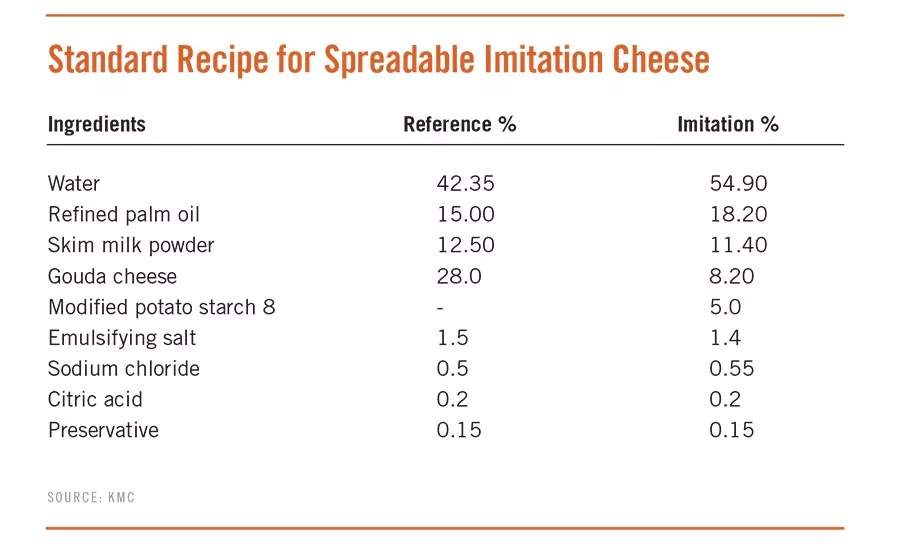
Other types of modified potato starches with different functionalities can be used to make hard cheese alternatives or spreadable imitation cheeses.
Slierendrecht concluded with the following guidance. “Modified potato starch solutions can replace milk proteins and enable the product developer to obtain significant cost-savings. Choosing the right starch is important for the application and requirements to the product. Imitation cheese products can be made with customized melting and textural characteristics without compromising too much on quality or making the implementation of the product too difficult in production.”
“Stretching the Idea of Cheese: Cost-effective Solutions for Imitation Cheese,” Helma Slierendrecht, PhD, senior technical sales manager, KMC Phone: 45-40-64-04-89, hsl@kmc.dk
Including Pulse Flours in Baked Products
The USDA Farmers Bulletin, of March 1918, stated that abundant crops of corn, rice, potatoes, oats, barley, buckwheat, kafir, milo, feterita [a Sudanese sorghum], peas, beans or peanuts could be used in larger or smaller amounts in place of wheat flour in bread baking. It also said that such breads would have even greater nutritive value than if made from wheat flour alone. In other words, pulse flours are not new; they have been making a comeback. Different milling methods create flours with varying particle sizes and ranges of distribution—each offering a unique functionality.
Many consumers are looking for foods that are non-GMO, have low allergenicity, and are wheat- or gluten-free. Consumers also increasingly seek clean and clear labels with few ingredients and no chemical names. They are more sophisticated in understanding sustainability and how it links to food production.
“And consumers want more protein, fiber and micronutrients,” elucidated Margaret Hughes, vice president, sales & marketing at Best Cooking Pulses, Inc., in her PF R&D Seminar presentation titled “Including Pulse Flours in Baked Products.”
“Consumers are linking food to potential health benefits, such as decreased risk of coronary vascular disease and type II diabetes,” Hughes continued.
There has been significant collaboration with food product research organizations to evaluate cooking pulse flours in a range of product applications; in one study, 100% whole-wheat flour bread was compared with bread from a blend of either 15% proprietary whole pinto bean flour or 15% proprietary whole green lentil flour. Findings indicated the pulse flours provided excellent moisture retention, water- and fat-binding capabilities and emulsion stability. They also were found to act as a thickener with potential for replacing gums.
Some 4% gluten was used for breads with pulse flours (2% for control). Slightly longer mixing was needed for doughs including pulse flours; bread made with pinto bean flour required a longer final fermentation. Both pulse flours produced sticky doughs but were manageable at the moulder. The addition of pulse flours had only a minor impact on loaf volume and produced breads with higher bread scores than the control. Breads made with both pulse flours had acceptable flavor profiles.
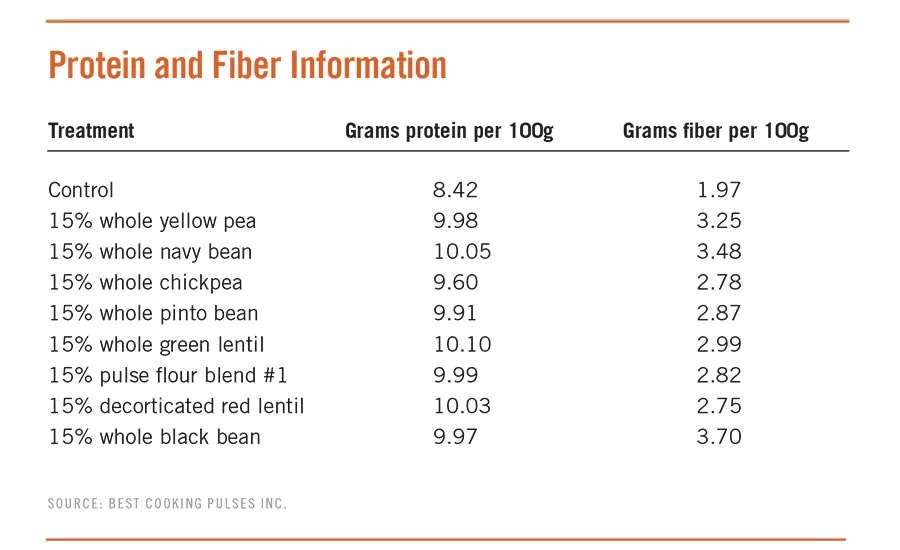
In another study looking at white bread, a variety of proprietary pulse flours were used at 15%, with 2% gluten addition, and several proprietary pulse flour blends. All the pulse flours produced strong doughs. Chickpea flour produced a smooth, strong dough. Decorticated red lentil flours produced a smooth dough with signs of weakness at the moulder but was bold coming out of the proofer. The whole green lentil flour produced a smooth dough with good handling properties, but it had some blisters and signs of weakness out of the proofer.
“The proprietary pulse flour blend had the best baking absorption and dough-handling properties, [as well as] the best loaf height, crumb color, texture and flavor of all the pulse flours tested,” added Hughes.
Pulse flours also increase water absorption and decrease mixing time in tortillas. In pita bread, successful products have been made with 25% yellow pea flour, 25% chickpea flour and 25% green lentil flour. Whole pinto bean flour is also useful in gluten-free pita bread and pizza crust. Protein and fiber claims are possible with the right combination of pulse flours.
“Including Pulse Flours in Baked Products,” Margaret Hughes, vice president, Sales & Marketing, Best Cooking Pulses Inc., margaret@bestcookingpulses.com, 204-857-4451
Originally appeared in the February, 2017 issue of Prepared Foods as Imitating with Allergen-Free Formulations.
Looking for a reprint of this article?
From high-res PDFs to custom plaques, order your copy today!


