New Food Fusion Trends
Korean-Mexican, Japanese-Italian, Middle Eastern-Southwestern…all make for strange, but tasty, bedfellows
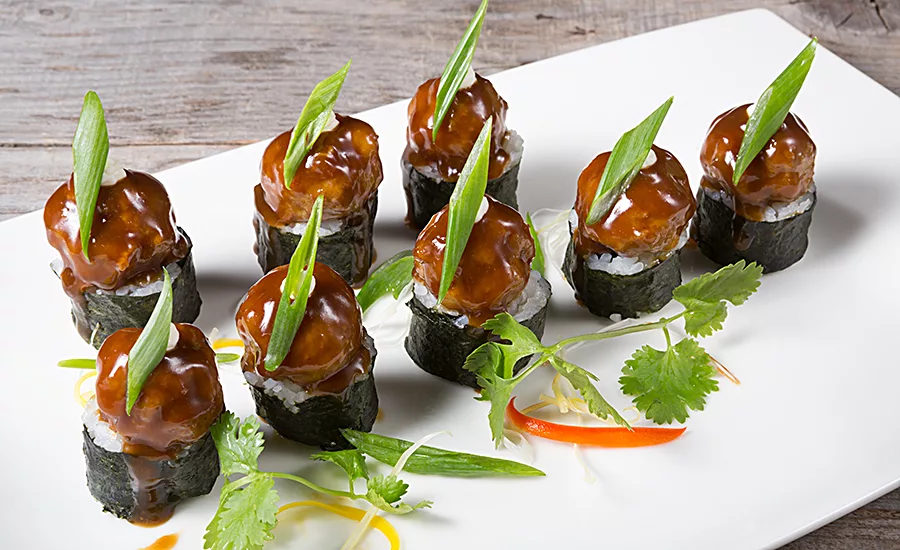
SOURCE: fotolia/Duke (us.fotolia.com)
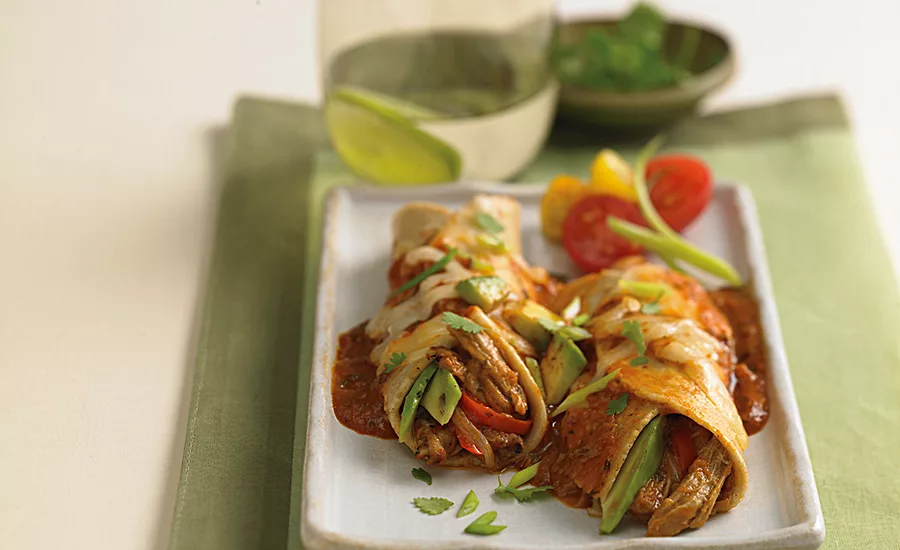
Soy sauce provides an umami flavor note that can connect multiple ethnic flavor palettes, such as with Indian-meets-Chinese-meets-Mexican pork tikka masala enchiladas.
SOURCE: Kikkoman USA Inc. (www.kikkoman.com)

Whether fusing, mashing up, or smashing, product developers must “walk a culinary tightrope” to ensure the resulting formulation isn’t too complicated for consumers.
SOURCE: McCormick & Company, Inc. (www.mccormick.com)
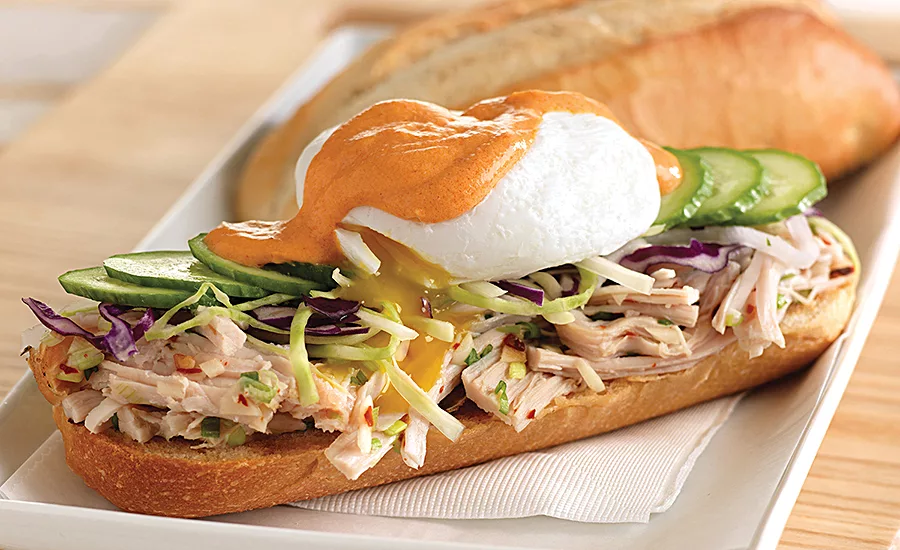
Universal ingredients, such as eggs, provide a familiar and facilitating bridge between more sharply differentiated culinary styles.
SOURCE: American Egg Board (www.aeb.org)
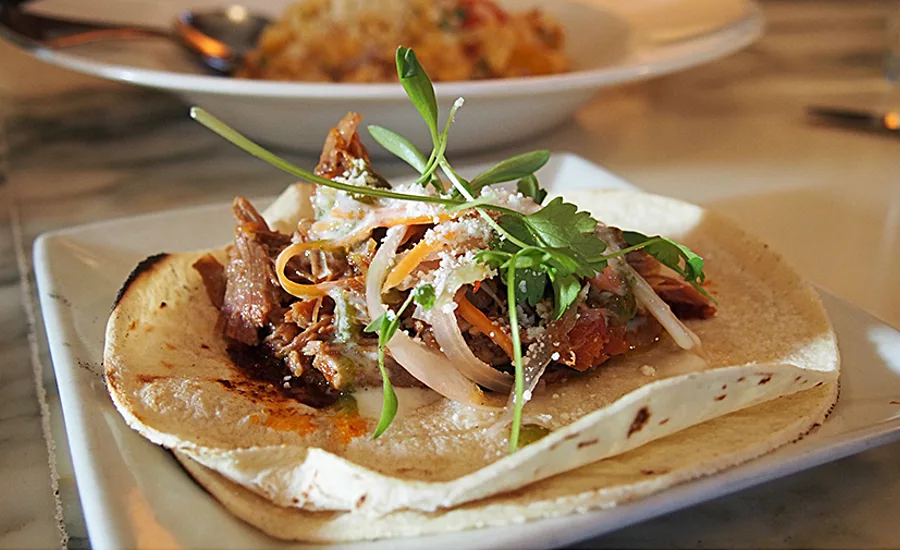
Flavor experts and culinologists have helped push “Food Truck fusion” into the mainstream through the artful use of disparate flavor components.
SOURCE: Bell Flavors & Fragrances Inc. (www.bellff.com)

Dessert formulations are not exempt from the fusion trend, as exampled by the infusion of Indian chai spice into a classic Mexican flan.
SOURCE: McCormick & Company, Inc. (www.mccormick.com)
During the past 20 years, a “flavor fallout” has blanketed the US. Traditional cuisines and flavors have been infiltrated by, and infused with, a sprinkling of flavor notes from other cultures. As a result, American consumers have embraced a variety of ethnic cuisines and their flavors, the more authentic—and, in some cases, more exotic—the better.
What used to be strange has become a “discovery.” Whether it’s sriracha for its mild, sweet heat or ghost peppers for their blistering fire, US consumers are all about the new and different. But, being Americans, they also are driven to add their own touches. With demand accelerated by the continued influx of people from all over the world, the fusion of different cuisine ingredients and styles is beginning to graduate from restaurant kitchens to manufacturers of meals and snacks designed for the mainstream.
Some of the latest food trends involved in contributing their influences to this transition include Latin flavors from Mexico to Peru; Korean; African (from the North’s harissa to the South’s peri-peri); and street food from anywhere and everywhere, especially Thailand and Mexico’s interior. And, with Cuba just opened up, and flowery guava to meaty black beans to starchy plantains and pungent marinades and sauces, such as mojo and sofrito.
According to research from the American Egg Board (AEB), foreign cuisines have become a “national obsession.” Keeping abreast of food trends has become active, rather than passive—with consumers rushing to “follow Tweets from the top Thai brunch place in town and stream all Food Channel shows on regional Peruvian cooking.” The AEB noted that consumers today will “know the weekly schedule of [their] favorite fusion cuisine breakfast truck and Instagram every item [they] order at the Korean burger place just opened by that celebrity chef.”
Young and Hungry
Several issues are driving this trend. As Boomers yield their generational influence and impact to Millenials, the 35-and-under crowd is now shaping how people think about food and flavor. After all, this demographic accounts for 25% of the US population. Moreover, it is the most diverse demographic in the country’s history, and the most inclusive and inquisitive, readily embracing cultural ideas of “others”—from lifestyle to cuisines.
Millennials also inherited Boomers’ fascination with food. They’ve grown up with myriad cuisines and an infinitude of flavor. Many of their family meals were consumed outside the home, instead of around the dining table. Knowledge about food, cooking, restaurants, chefs, and social media (as it relates to food) is second nature to them. More than ever, food fluency is even taking on status as a social and business requirement. You are what you know about food, not just what you eat.
Social media has provided a lush breeding ground for both food knowledge and cultural culinary mixing. Instagram and Buzzfeed, with its sub-group “Tasty,” as well as Facebook’s Tastemade page (already at some 2 million likes, not counting Facebook/Tastemade Japan or Tastemade Brazil or any of the other national Tastemade pages) inform and educate younger consumers about culinary nuances with viral speed.
These sources include 30-second, “how-to” food videos, recipes, questions and answers, and other resources, as well as non-stop chats about food. And, throughout all these sources, one common theme is that of culinary mash-ups, such as bacon jalapeño pastries or quesadillas made with monkey bread.
The National Restaurant Assn. recently reported that 90% of foodservice operators found consumers are more knowledgeable about food and pay more attention to food quality than even two years ago. With all this food fusion happening in restaurants and foodservice, the next step is how it works its way into prepared foods.
In restaurants, new fusion cuisines are well-represented by breakfast items, according to the AEB. One can point to such up-and-coming items as egg burritos, huevos rancheros and chilaquiles that have influences outside of Latin America.
Other examples are a Peking duck with fried eggs, pickled onion, guajillo salsa, cotija (Mexican grating cheese), crema and corn tortilla at Zengo in Washington, D.C. A Cuban connection is found in Denver at Snooze Eatery in its Havana Daydreaming dish, made with free-range pork, shaved ham, Gruyère, and homemade pickles, crowned with a sunny side-up egg and napped with Dijon hollandaise.
Even more exotic, the AEB points to harissa-braised kale with apple wood-smoked lamb bacon and fried eggs, served at The Breslin restaurant in New York City; and The Kenwood in Minneapolis’ approach of Korean-style shrimp and grits with ramps, shiitakes, poached egg and K-mama brand sauce. Or, there’s Caribbean-meets-Southern, in a dish of eggs over easy, plantains, stew peas, and Scotch bonnet pepper, from Miss Lilly’s in Soho.
Deciding to mix two or more culinary profiles in a single dish can be daring, but when done with expertise, the results can prove to be more than the sum of their individual parts.Catching the Wave
Prepared foods manufacturers are carefully applying resources to interpret this wave of interest in a confluence of cuisines and flavors. But such interpretation poses unique challenges.
Diners in a restaurant or queuing up to a food truck might have the time and inclination to step out on a culinary ledge to try Thai-influenced Swedish meatballs served on a bed of Bolivian quinoa with a julienne of Japanese nori. But will that same consumer, as a shopper, take the time to digest that kind of fusion product while rushing in a fast cruise down the frozen food aisle?
Experts are, as yet, unsure of the answer to this question. Some have suggested Millennials will demand that prepared food products reflect the same choices of fusions and cuisine mash-ups they love in restaurants and food trucks.
Others believe the combinations are too complex for a hurried, harried shopper. Better to stick with ethnic “authenticity” in prepared foods to appeal to consumers’ cravings for the new and different, and/or more healthful, without adding time-consuming confusion.
To get a better handle, culinologists point to the need for better definitions of just what culinary fusion is. “The word ‘fusion,’ in some ways, is the other ‘f word’,” says Andrew Hunter, R&D chef, author, and mentor on Lifetime Television’s competition series, Supermarket Superstar. “‘Fusion’ too often has become like the Edsel of the car industry—a result of bad execution.”
That doesn’t mean it’s a bad idea when called by another name. “Mash-up” has become the new, operative term for fusion cuisine; it is used to imply a mixture of disparate elements. Hunter prefers the word “smashing” to describe what can happen with successful fusion. He credits chef Mark Miller with coining the term in relation to multicultural cuisine.
“What I like about the idea of smashing is that it means layering disparate flavors that remain in total harmony,” says Hunter. “A classic example of smashing,” he adds, “is the approach taken by Korean-American chef Roy Choi. Famous for creating the gourmet Korean taco truck, Kogi, Choi is considered a founder of the food truck movement.”
“Smashing is about experiencing two or more cuisines, one after another, in a single bite,” adds Hunter. “Kogi BBQ’s micro-regional tacos illustrate a form of smashing, with Mexican corn tortillas topped with Korean marinated beef and pork belly, then topped with kimchi and finished with salsa verde. Korean and Mexican cuisines are smashed together into a delicious composition called ‘Angeleno’—it’s multiculturalism on a plate!”
Fusion Challenges
Some experts feel that, in the prepared foods space, consumers will be confused by fusion. Whereas consumers love authentic ethnic cuisine products if they are executed in a way that makes them understandable and accessible (and/or more healthful), they could be unwilling to invest enough time and effort to understand what a prepared food mash-up is supposed to be.
For many product developers, it has been enough of a challenge helping consumers relate to authentic prepared products they can purchase at the supermarket. The impetus is to keep an ethnic cuisine product simple and understandable, without sacrificing authenticity of flavors.
Such products do not use terms, ingredients, or formulations that are considered too complex and unfamiliar. This is the predominant state of many products on supermarket shelves today. “Foreign” products are Balkanized by nationalities and geography—Mexican, Chinese, Italian, Greek, etc.
A great deal of attention is paid to consumer attention span. When ordering in a restaurant or lining up at a food truck, the consumer is more relaxed, even when the format is fast-casual. The setting creates the space and sets the stage for engaging with the concept and thus the elements of a preparation.
For most of the clients, there’s a built-in curiosity about the chef or the setting that opens the way for experimentation and inclines the purchaser toward expectations of new or uncommon flavors.
In a supermarket setting, however, the shopper is typically in a “hurry-up” mode, executing a chore. Consumers do not often give a product more than a quick glance. If it doesn’t explain itself instantly, they might not be willing to engage. The window to grab a shopper’s attention is tight, and most don’t have the time or mind-set to open up to new or unknown dining possibilities.
“One major difference between a taco truck or restaurant and a line of prepared foods is the necessary target market,” explains Jody Denton, executive research chef for PepsiCo.’s Frito-Lay Inc. “A restaurant or a truck can appeal to a narrow population and still be busy. When trying to market a prepared food, the line has to have wide appeal to a general population. When you start getting too ‘out there’ on the flavors, you can’t market it as broadly as you need to.” Denton points out how reluctant many larger companies might be to go for a niche market or to embrace a “polarizing” dish.
Fusion Promise
In spite of this, trends inexorably are moving toward fusion concepts, according to other experts. They cite the way new ethnic cuisines have moved rapidly from restaurants and food trucks to foodservice and prepared foods. However, the pace is still relative. Manufactured food products still tend to evolve a lot slower than even foodservice.
Yet fusion cuisine for the mainstream is happening. Nestlé USA Inc. introduced Hot Pockets Food Truck Bites and Food Truck Sandwiches in June of this year. These frozen products were inspired by dishes served from trend-setting food trucks in L.A. and Chicago, including Komodo, Baby’s Burgers, and Toasty Cheese Mobile Eatery. One example, via famed L.A.’s Lobos Truck, combines dark meat chicken, jalapeños, cilantro, and corn with a spicy ginger-lime sauce in a mini spring roll.
Emily Mundy, a culinologist and nutritionist for CuliNex LLC, self-describes as a typical Millennial who is “totally into food.” Mundy believes her generation expects manufactured foods to keep up with trends more quickly. “Retail brands are really going to have to step it up and get out of the comfort zone,” she warns. “The key is to use trending, authentic flavors in a new way.”
Explaining further, Mundy points out that consumers “already understand tacos, pizza, and burritos; they don’t have to wrap their heads around those kinds of dishes. Using an understood dish or format with a different flavor profile combines familiar with new for ‘shock factor’ and interest in something that hasn’t been done before.” She posits a hypothetical approach to banh mih, the popular Vietnamese sandwich (already a prefiguring mash-up of French and Indochinese culinary traditions) as a flavor template for tacos or pizza.
Moving into the Zone
For culinologists approaching new fusion cuisine, it’s helpful to start with a familiar platform—pizza for example. Then, add something untypical, such as a crema layer and a topping of shredded Peking duck and guajillo salsa. Also, think about genres that best lend themselves to mix-and-match: snacks, shared plates, appetizers, and breakfast and street foods.
Bowls are natural platforms for mash-ups and smashing; wraps, sandwiches (especially breakfast sandwiches), pasta, burritos, tacos, hummus, potato chips, and flavored yogurt with dippers also work. Especially adaptable to this style would be anything eaten out-of-hand.
Next, the chef can consider seasoning bridges, such as garlic, coconut milk, sesame oil, lime, soy, and sriracha sauces. These are traditional enough, unique enough, and now familiar enough to help a formulation make the move from restaurant and food truck fare to prepared foods. When it comes to food products such as these, the mother sauces are barbecue, ranch, and tomato sauce for pizza. All can blend well with ethnic signatures. For example, hoisin (sweetened soy barbecue sauce), with its traditional five spices, works well with tomato to give a product an Asian flavor signature.
Chef Hunter acknowledges he particularly is interested in the way coconut milk can bridge cuisines. “Coconut milk is my favorite ingredient lately, because it is so versatile,” he says.
Hunter also acknowledges being a big fan of using some of the fast-
trending Middle Eastern ingredients, such as hummus, as the base for fusion combinations. Moreover, Mediterranean staples, including olive oil, garlic, and lemon, can be blended with specific spices from other cuisines, such as curry or
Arabic seven-spice blend for a completely different profile and, thus, a new identity.
Center of Plate
Center-of-plate proteins also are great platforms for going fusion. “Chicken and eggs are great blank palates on which to paint mash-ups,” says Steve Solomon of the AEB, “In the US, we’ve also ‘chickenized’ the world’s most available animal protein: pork.”
Basically, any ethnic dish that uses pork can substitute chicken. “Chicken can do anything,” agrees Robert Del Grande, PhD, partner in Schiller-Del Grande Management LLC, and executive chef and owner of Café Annie. “Because it is a great base for a lot of flavors, it is economical to make it not boring.”
Mimicking the classic Chinese balance triad of salt, sweet, and sour can be a vehicle to new flavors. Ditto bacon—with its salt, sugar, and fat. “Everything tastes better with bacon,” laughs Del Grande, who knows he’s not the first to say it. “In all seriousness,” he explains, “bacon has a very appealing mouthfeel. If you layer other flavors with it, it can be exciting. It’s one more way to fulfill consumers’ need for emotional excitement with food.”
Still another approach, according to Raminder Bindra, founder and CEO of Seven Spoons LLC, is to blend the core ingredients from different cultures, rather than the seasonings, thus keeping the familiar flavors of one. One such example of this approach would be a biryani (a traditional South Asian rice dish) made with quinoa instead of rice to up the protein quotient. This combines the traditional, high-protein Andean grain seasoned with traditional Indian spices. However, Bindra cautions, flavor fusion simply for the sake of fusion doesn’t work.
The key to fusion cuisine, suggests culinologist Mundy, is to use authentic flavors in a new way. “Go granular, she advises. Don’t just think regional ethnic cuisine, i.e., Asian or Thai. Think about specific dishes such tom kah kai (Thai coconut chicken soup) or pad Thai. “Retail brands are really going to have to step it up and get out of their flavor profile comfort zones,” says Mundy.
Originally appeared in the October, 2016 issue of Prepared Foods as New Fusions.
To Fuse or Smash
Andrew Hunter, R&D chef, author, and mentor on Lifetime Television’s competition series, Supermarket Superstar, describes the differences between fusion and “smashing” in fine detail. “Whereas fusion is about blending flavors from different cuisines, smashing is about combining unique layers of flavors tasted separately and then together. Fusion, done correctly, is about harmonizing unique flavors; while smashing can be harmonious, it also challenges diners’ comfort levels and traditional sensibilities about flavor combinations.”
New Fusion Math
“Sometimes, fusion comes out as 1 + 1 = 11, rather than 1 + 1 = 2,” computes Raminder Bindra, founder and CEO of Seven Spoons LLC. He explains that combinations that are greater than the sum of their parts are a great way to bring creativity and healthfulness into fusion. For example, savory aromatics, like onions and garlic, are good comfort bridges, because they’re used in most cuisines. Combine signature herbs and spices from different cuisines, i.e., cilantro, basil, and green onion, with these bridges to create new profiles, Bindra suggests.
“Swap sweet and savory, such as mango yogurt with a sriracha stir-in, or a hummus with a jelly swirl. Stuff one identifiable item into another item,” he suggests, “such as a burrito inside a quesadilla; nachos in a sandwich.” Whether you call it fusion, mash-up or smashing, the multi-cultural blending of cuisines, flavors and ingredients is the new and fast-approaching frontier of prepared foods.
Looking for a reprint of this article?
From high-res PDFs to custom plaques, order your copy today!


