Gum and Starch Solutions
Prepared Foods' R&D Application Seminars presenters share formulation insights using gum acacia and potato starches
Gum Acacia: New Technology for Non-GMO Applications
Gum acacia is a tree exudate sourced from nature by collection from wild trees in Africa. Available in spray-dried or instant soluble forms, the gum is a fully traceable, sustainable and organic product. Gum acacia is an odorless, tasteless, colorless, highly water soluble, multi-functional polysaccharide. A highly safe food additive also known as gum Arabic, gum acacia is ideal for dietary applications and fiber-enrichment purposes.
Offering numerous functional properties, gum acacia is today found in thousands of products. There are two main grades of gum acacia: Senegal gum and Seyal gum. Acacia Senegal has more negative charges, due to higher amounts of glucuronic acid and a different proportion of sugars than acacia Seyal, so it behaves somewhat differently in products.
In a recent R&D Seminar entitled “Gum Acacia: New Technology for Non-GMO Applications,” Isabelle Jaouen, R&D director, Alland and Robert/Farbest Brands, explained: “Also associated with gum acacia is a small amount of arabino galactan protein, the amount correlating with the main functional properties of the gum.” Senegal gum has 2% protein, while Seyal gum contains 1% protein.
Functions of both acacia Senegal and Seyal include acting as a texturing agent with influence on the viscosity and body. As a film-forming agent, it protects against moisture and contamination. In dry mixes for water-soluble substances, it is used as a carrier and bulking agent; and to increase fiber in formulas needing high amounts of soluble fiber.
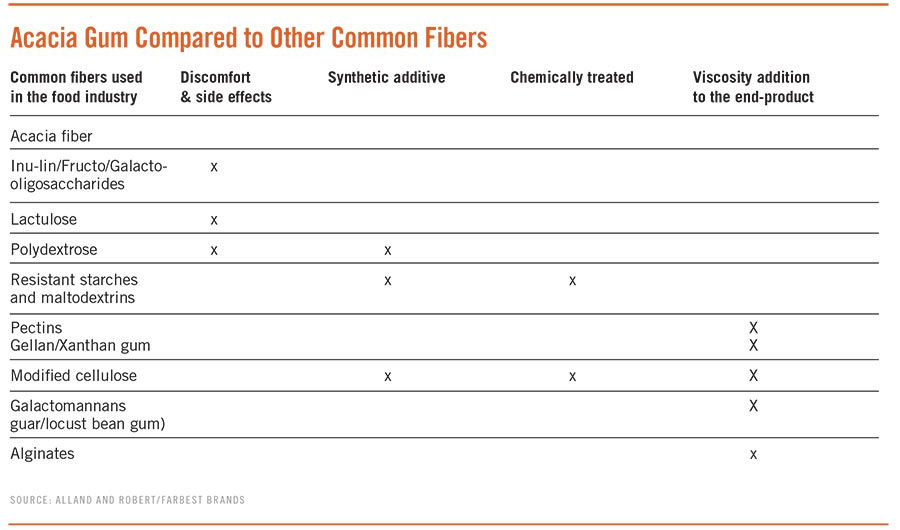
As a fiber, acacia gum offers several advantages, including resistance to acidity and heat; no discomfort or stomach issues; neutral taste with very low viscosity; very low glycemic index; and scientifically recognized prebiotic effects.
“Some properties attributed specifically to acacia Senegal include as an emulsifying agent in oil-in-water emulsions,” Jaouen added. It also helps avoid crystallization of sucrose, improving the quality of confectioneries. It likewise protects color and improves mouthfeel of products. Gum acacia is used in many industries, including flavors, confectionery, beverages, special diets, bakery, dairy, pharmaceutical and cosmetic.
Gum acacia is in line with all the growing trends for consumer goods, including clean and clear labels, organic, GMO-free, allergen-free, vegan, vegetarian, fiber-enrichment and fat-reduction. And, a study by the Laboratoire d’Essais des Materiels et Produits Alimentaires/Laboratory for the testing of food products was done to characterize the effects of adding acacia gum to bread. Tests were done on both grades of acacia gum, at three dosage levels, (1, 3 and 6%, respectively).
The breads were assessed for sensory evaluation with a panel of 60 people answering a questionnaire for each product, on a scale from one to nine: one being highly unpleasant; five being neutral; and nine being exceptionally good.
“The addition of both Seyal and Senegal in sandwich bread offer offered a higher softness after four days; however, the recommendation for bread softness would be to use the Seyal at 1-3% for best results,” stated Jaouen. The addition of acacia gum Seyal offers the best final weight, due to better water retention than Senegal. The more acacia gum added, the higher the moisture retention.
For gluten-free breads, Jaouen recommends either acacia gum Senegal or Seyal at 3% for both softness, preservation and fiber fortification. Senegal is recommended in gluten-free bread, for higher moisture retention after four days. In sensory studies, both white sandwich bread and gluten-free bread with added acacia gum were ranked better than controls.
At a minimum fiber content of 90% (AOAC 985-29), fiber enrichment with acacia gum can allow for fiber claims in many countries. Again, gum acacia is in line with all the growing trends for consumer goods, including clean and clear labels, organic, GMP and allergen-free, vegetarian/vegan, fiber enrichment and fat reduction, as well as sustainability and social responsibility.
“Gum Acacia: New Technology for Non-GMO Applications,” Isabelle Jaouen, R&D director, Alland and Robert/Farbest Brands, 201-573-4900, information@farbest.com
—Summary by Elizabeth Pelofske, Contributing Editor
The Benefits of Cold-water Swelling Potato Starches in Different Product Formulations
Starches are easy-to-use ingredients that have long shelflives and can be stored at ambient temperatures. They are versatile, plant-based ingredients with a wide range of functional properties that enable their use in many applications.
When heated with water, the starch granules absorb water and swell, until they reach their gelatinization temperature—which is when thickening or gelling occurs, as the starch branches extend and spread out. As the starch gel cools down, the starch chains retrograde or crystallize. As shown on a Brabender amylograph, gelatinization temperature is when the starch is at the maximum viscosity. Pasting temperature is known as the onset of gelatinization.
“Potato starch differs from other starches by having a very high peak viscosity and low gelatinization temperature,” explained Helma Slierendrecht, Ph.D., senior technical sales manager, KMC, in a Prepared Foods R&D Applications Seminar titled “The Benefits of Cold-water Swelling Potato Starches in Different Product Formulations.”
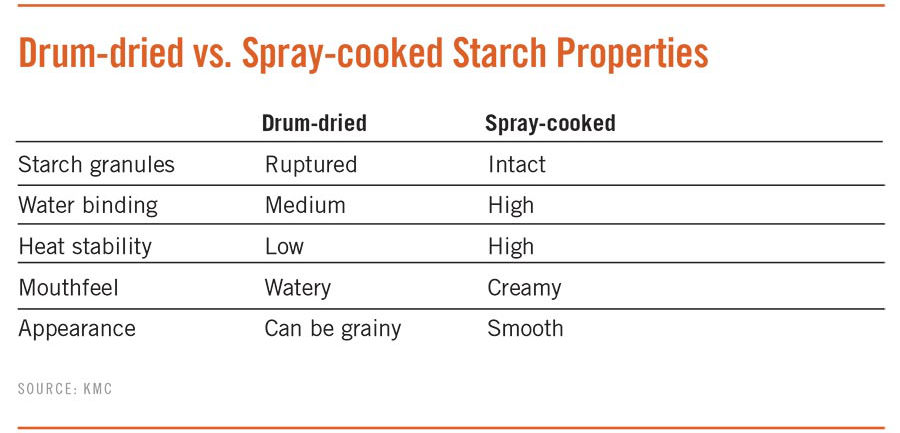
Drum-drying is a harsh starch-production method causing loss of starch granule integrity. Spray-cooking is gentler and leaves the starch granules intact, resulting in the following starch characteristics.
Native starch has some limitations as it breaks down under shear or acid conditions; it has poor tolerance to heat and a narrow peak viscosity; and it must be cooked. “In food applications, it is slow-gelling; has a long structure; and does not store or freeze and thaw well,” added Slierendrecht. “Starches can, however, be modified to make them more stable towards storage and process conditions. Modifications can also change the texture, appearance and clarity in the food application.”
Starches usually require heating, but this can be overcome by using pregelatinized or instant starches. Drum-drying is a common method to manufacture those, but drum-dried starches often lose a lot of their granular integrity, and there will be small fragments present. Spray-cooking is a gentler way of producing instant starches. The starch slurry gets uniformly cooked in the spray-dryer nozzle, and the starch granules remain intact. These spray-cooked or cold-water swelling (CWS) starches are therefore high-performance products that can be dosed lower–up to 15%–making them a cost-effective solution.
Cold-swelling potato starches are cost-effective, allowing for lower energy costs, shorter production time, less production steps and lower usage levels. They still have the same characteristics as cook-up potato starches regarding flavor, color and consumer preference.
Potato starch can replace or reduce many other expensive ingredients, such as milk protein, gelatin or eggs in many cases. They are easy to implement—with high stability, ambient storage temperature and long shelflife. With a broad range of functionality, potato starch can ensure customized products and process and storage stability.
Slierendrecht offered that “potato starch has application in plant-based or vegan products, and it is non-GMO and non-allergenic. It provides a white color and neutral taste, and excellent flavor release,” she added. The cold-swelling potato starches, especially, are great for bakery fillings, sauces, soups, mayonnaise type products, and other savory products.
“The Benefits of Cold-water Swelling Potato Starches in Different Product Formulations,” Helma Slierendrecht, Ph.D., senior technical sales manager, KMC, hsl@kmc.dk
—Summary by Elizabeth Pelofske, Contributing Editor
Originally appeared in the May, 2018 issue of Prepared Foods as Gum and Starch Solutions.
Looking for a reprint of this article?
From high-res PDFs to custom plaques, order your copy today!


