Trends in Prepared Foods for Foodservice

a. Have a nice leisurely dinner at a white-cloth restaurant--call spouse and give him/her directions.
b. Make a quick stop at Applebee's--have kids head over after their baseball game.
c. Pick up Taco Bell--eat in the car or at home.
d. Prepare a complete dinner at home from scratch--clean up, do dishes and take out the trash.
It is not surprising that statistics on the foodservice industry reveal that consumers are selecting a, b and c more frequently. Foodservice (retail sales equivalent) is projected to be $501 billion for 2006, according to Technomic Inc. Restaurants (both limited and full service) and bars constitute 64% of this total, with the remaining 36% being distributed among smaller players such as retail, foodservice, healthcare, travel, schools and the military.
To better understand what forces are driving the industry, Prepared Foods conducted its second annual “Foodservice Product Development Trends Survey,” with the goal of “examining the challenges and opportunities in product development to provide prepared foods to restaurants and institutions.” In 2006, 158 respondents shared their views on key issues and challenges. The group spanned a cross-functional range within the foodservice industry: R&D, marketing, sales, general management and administration, and plant operations and production. Approximately half of the perspectives came from R&D personnel, while marketing comprised about one-fourth; the remaining one-fourth was scattered among the other functional areas.
Interestingly, a full 61% of respondents expect foodservice sales in their company to increase over the next two years, as contrasted to only 55% for retail channel sales. How can an individual manufacturer best increase its chance of success in this growing industry? The 2006 Prepared Foods survey posed several questions aimed at finding the answers.

The Importance of Quality Control
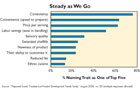
The survey asked, “What are the top five most important product traits to your foodservice customers?” (See chart “Steady as We Go.”) The first four factors--consistency, convenience, price per serving and labor savings--were mentioned by 50% or more of all respondents. Some key players in the foodservice industry were willing to expound on the subject.Dan O'Connell, president of Foodmix Marketing and Communications, says, “Improvements in consistency, convenience and labor savings are increasingly being introduced by manufacturers by coming to their operators with pre-researched solutions. Many kitchens deal with the challenges of lesser-qualified labor, lack of adequate refrigeration and limited space. Anything a manufacturer can do to ease these concerns and perhaps take a step or two out of the process, can be a differentiating factor, whether it is pre-grilling vegetables, changing a soup base to a broth or providing a packaging system which does not require refrigeration.” O'Connell emphasizes that the role of the foodservice manufacturer is no longer to sell products, but to sell solutions or “sell to the menu.”
Michael Belica, vice president of new business development for Dutch Farms, applies similar insight to his company's foodservice egg business. The pasteurized in-shell eggs reduce the number of food safety steps in kitchens. “Consistency and convenience largely drive our business...skilled labor in the kitchens is not always available and, when it is, the turnover rate is very high. So, by keeping our product consistent and convenient to prepare, our customers can produce great results with minimum preparation time and a lower level of training. They want products which facilitate ease of handling in the kitchen, yet provide consistent plate appeal.” He further adds, “Quite often the task is not how to make the product better--but rather, how can the operator have fewer workers in the kitchen?”
Price per serving is extremely important to foodservice customers, with some 68% of respondents reporting that foodservice clients are more price sensitive than their retail counterparts.
John Li, senior executive chef for Kraft Foodservice, brings an interesting perspective to the role of price--and the willingness of consumers to trade off other valuable attributes when price savings are possible. Li comments, “Macro consumer trends in consumer spending habits have led to a trading up and down behavior in many categories, including dining out, that has affected all 'away-from-home' segments. And with this split in the marketplace, quality expectations have risen. Quality can be defined by many drivers and is not always simply defined. It can include taste, service, temperature of the food and ambiance. However, along with this new spending behavior comes a much savvier price- and value-conscious consumer.”
Chef Li believes consumers base their decisions using a “value calculus,” a concept fully discussed in the book Trading Up/Treasure Hunt by Neil Fiske and Michael Silverstein. Fiske is CEO of Bath and Body Works, while Silverstein is a senior vice president of the Boston Consulting Group. Value calculus explains that consumers evaluate their “food away from home” experience on all factors, not just price. While consumers may “trade up” at Panera--and happily pay a premium for an emotionally satisfying product--they may “go on treasure hunts” at Costco, while getting just as much emotional satisfaction. Companies like Kraft have devoted extensive time and resources to understand these seemingly contradictory behaviors in order to help operators better plan and adjust their menu strategies.
World Cuisines
Another important issue in foodservice, as well as all food channels, is the issue of increasing ethnic food exposure--and the resulting impact on product development efforts. As consumers become increasingly exposed to new cuisines—through travel, ethnic neighbors and friends, and cooking shows--how will their “food away from home” purchases change? In the survey, Prepared Foods also hoped to determine which ethnic cuisines are becoming more or less prominent in foodservice offerings. (See chart “Here, There and Everywhere.”)Both this year and last, the most popular preparation styles in the survey were Mexican, kosher, Italian and Chinese. Chef Li's more extensive research at Kraft, consisting of both national and global quantitative research on both food and cooking technique trends, confirms the existence of three primary ethnic categories: Chinese, Italian and Mexican. Chef Li shares, “Boomers have been very accepting of global flavors, but it's their kids, the Millennials (born 1980-1997), who will drive the need for manufacturers to incorporate these flavor trends into their product solutions for the operators.”
Kraft is responding to consumer trends demanding bolder ethnic flavors—but in familiar formats. For example, it has created three new flavors of A1 burger spreads specifically for steak burgers or steak sandwiches. The flavors include a Latin-inspired Orange Chipotle, a Mediterranean-inspired Sun Dried Tomato with Roasted Garlic and a bold, contemporary American flavor profile of Roasted Garlic and Dijon.
Chef Li predicts that as the foodservice industry continues to change and expand rapidly, there will be an influx of new players entering the market with exciting new options based on Southeast Asian, Indian, Lebanese and Cuban cuisines.
Foodservice manufacturers such as McCain Foods, with its Latin Latitudes line, have already capitalized on the success of Caribbean-inspired cuisine. McCain Foods CEO Frank van Schaayk has publicly noted the need to bring more growth and creativity to the prepared snack/appetizer category, and innovating with ethnic or fusion-inspired introductions may be the answer.
The survey also asked the follow-up question: “For each ethnic product offered by your company, please indicate if product development efforts will increase, decrease or stay the same over the next two years.” (See chart “Product Development Efforts.”)
Mexican food, already the most commonly offered ethnic product, will continue to see more development efforts, with a full 73% of respondents planning to increase development time. Only 21% of respondents plan to dedicate the same amount of time, and just 6% expect to decrease the existing development time. The popularity of Rick Bayless' show, Mexico—One Plate at a Time, is a testament to the general interest surrounding Mexican and Mexican-inspired cuisines.
Kosher products, offered by 40% of respondents, hold a different expectation. Less than one-third, only 29% of respondents, expect to increase product development time. Though none expect to decrease efforts, a full 71% expect to dedicate the same amount of product development time to kosher products.
Italian food is offered by 38% of respondents, and 58% expect product development time to remain the same. Meanwhile, Chinese food is offered by 33% of respondents, and 56% of them expect to dedicate the same amount of time to product development.
It is interesting to note that these ethnic products are largely “Americanized” versions of authentic counterparts. The survey question “Would you rate the ethnic products your company will develop as very authentic or formulated to appeal to the mainstream public?” showed that close to 60% of respondents consider their “ethnic” products could more accurately be portrayed as “Mainstream/ Americanized.” (See chart “Even Better than the Real Thing.”)
Significant Trends
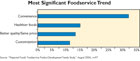
The Prepared Foods' survey also asked, “What do you think is the most significant trend in the development of prepared foods for foodservice distribution?” Convenience won out. (See chart “Most Significant Foodservice Trend.”)Starbucks grappled with the convenience issue this past summer, as soaring temperatures in New York drove consumers to seek something to cool off with--namely, ice-cold Frappucino. However, long lines occurred at some outlets due to the time required to prepare these drinks. The additional wait proved time-prohibitive to some customers and resulted in a slight downturn in summer sales. Starbucks' CFO Michael Casey has publicly stated that the service slowdown is an issue, and Starbucks is taking steps to deal with it.
The demand for healthier foods presents some interesting challenges for chef Li and his counterparts at Kraft. “Health and wellness is more challenging in 'food away from home' because some eating occasions are celebratory and social in nature, which changes the dynamics of how you design the foods and menu. Surprisingly, the health and wellness trend has spilled over into the fine dining segment. It's odd because fine dining is an indulgent experience, and now it has adopted a healthy focus as well,” he reports.
Chef Li illustrates Kraft's use of extensive research to better understand and address the needs of restaurateurs: “Innovative independent restaurateurs are being more creative by using relevant branding on menus, sourcing locally farmed produce and meats and incorporating more of a seasonal approach to new menu items. They are also introducing more all-natural, environmentally friendly and organic products and dishes. All of these tactics are perceived as reinforcing the benefit of better-for-you options. Consumers have redefined health and wellness. And, with aging Boomers and more self-aware Millennials, food will play a more important role in health and wellness initiatives.”
Though price is often fixed, the successful foodservice manufacturer will offer added value in the form of better quality. “Price per serving is the most important factor at the start of the project,” comments Pankaj Kandhari, food scientist, Advanced Food Products LLC. “Once we have an upper limit, we can do our best to get the best sensory qualities in a given range.”
Although price still plays a crucial role in a consumer's decision-making process, the willingness of consumers to sometimes trade price for flavor, health benefits or convenience creates a number of marketing opportunities for manufacturers and other foodservice professionals.
While this article provides an overview of the survey results, further in-depth information is available in the complete, published version of the “Prepared Foods' Foodservice Product Development Trends Study.”—Ed.
Anju Holay specializes in consumer research for the food & beverage industry. Contact her at 847-912-6398 or nextstepmktg@ameritech.net.
Looking for a reprint of this article?
From high-res PDFs to custom plaques, order your copy today!


