2019 Predictions: Colorants
Evolving Food Market Drives Natural Color Innovation
New natural sources and clean technologies expands the developer toolbox
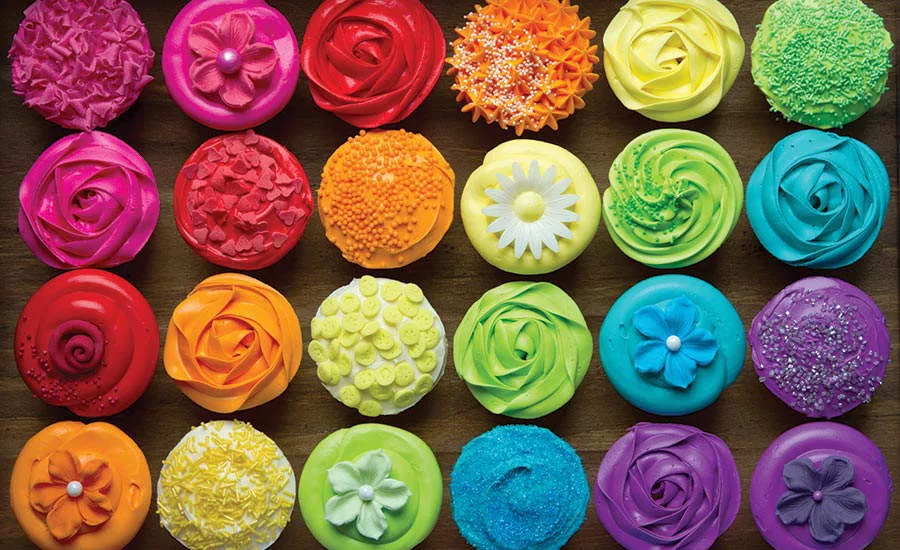
Increasingly available stable and vibrant plant-derived colorants are accelerating the shift from artificial to natural sources.
PHOTO COURTESY OF: getty images
It has been more than a decade since European packaged food manufacturers, spurred by a combination of consumer demand and regulatory changes, initiated a wave of conversions from synthetic to natural colors. More recently, a number of major North American packaged food brands and foodservice operators announced their intention to switch over to colors derived from natural sources.
It seems clear that transition to natural is global in nature. According to Mintel, more than 75% of the food and drink products launched globally in the first three quarters of 2018 used colors from natural sources versus synthetic options. Food manufacturers in Europe, North America, Latin America, and most of Asia are employing colors from natural sources in the majority of new product launches. Given the ever-increasing consumer demand for “naturalness,” there isn’t much reason to see this change slowing down in the near future.
Interestingly, one of the driving influences affecting the use of color in food and beverage products is social media “sharing.” According to Unilever, each day more than 3.5 million food photographs are shared globally. And, according to multiple sources, more than a billion conversations about food are shared annually on social media. This new social phenomenon has led to an increased use of color to develop visually interesting creations that inspire consumers to share. It also influences trends in the use of natural colorants.
An example of this influence popped up as “unicorn mania,” a social media fad that began with toast and incorporated a blend of vibrant blue, yellow, and red shades in cream cheese. The fad quickly spread on Instagram. Over the past several years, a number of leading brands have embraced the trend and created their own unicorn-inspired variations to drive increased consumer engagement.
The challenge for food product developers has been to deliver on both enhanced shade vibrancy and naturalness at the same time. Increasingly, that challenge is being met.
One thing holding back formulators from embracing the challenge of deploying natural vibrant colors in foods and beverages has been the perception that colors from natural sources are less stable than their synthetic counterparts.
In the past few years, artful technology has stepped in to change that, with considerable success. Food color producers have made significant advances in increasing both the range and the stability of natural colors across multiple applications. Here’s an update on some of those advances.
Truer Blue
A natural blue that is stable at low pH is considered by some to be the Holy Grail for the beverage industry. Spirulina brought a vibrant natural blue to the palette, but applications were limited due to certain stability issues. Soon, several new blue sources might be added to product developer’s color libraries; there is one color additive petition before the FDA and another in the pre-petition phase. These would increase the number of blue sources with their own listing in the regulations.
One of the new blue sources is gardenia blue, which already is an approved color in most of Asia. It is considered quite stable across a wide pH range. The shade is generally more denim-colored than its synthetic counterpart. A specific variety of butterfly pea flower that is reportedly extremely stable and suitable across a range of applications is another blue that could soon emerge. Both of these sources provide much greater heat stability than spirulina and are more suitable for high water-activity applications.
A blue colorant derived from juice of the huito, a tropical fruit from South America covered in last April’s issue, also could soon be petitioned as an approved color with its own listing. When combined with amino acids, huito produces stable blue shades in mid- to low-water activity applications.
Across the Spectrum
While the search for a bright natural blue suitable for low-pH beverages continues, other gaps have been filled. Heat processing, such as ultra-high temperature (UHT) in dairy, or extrusion used for cereal and pet food, historically created challenges for natural reds.
In addition to the novel blue sources noted earlier, a heat-stable beet red leverages advances in purification to prevent the browning typically experienced with other beet-based natural colorants. The technology enables manufacturers to achieve bright, heat-stable red shades in the neutral pH range using a vegetable juice. Lycopene can also provide an alternative for some applications.
Bright yellows, too, have been difficult to achieve in the past. Turmeric oleoresin provides highly desirable yellow shades, and ingredient technology has boosted the stability of this natural colorant. An added bonus is that, in combination with various blue sources, turmeric can be used to deliver a range of bright greens.
Because of turmeric’s light sensitivity, product developers might believe they have to avoid the color altogether. But a few color manufacturers have utilized encapsulation and microfine processing to create turmeric-based yellows that hold up better to light.
While the main driver for “clean” color is consumer perception and demand, the regulatory landscape continues to play a role as well. This is certainly true in the case of caramel, which faces headwinds from California’s Proposition 65, as it calls out both 4-methylimidazole and furfuryl alcohol as chemicals that might require label warnings. As a result, some food manufacturers have sought to replace caramel coloring to avoid any uncertainty.
Some new caramel browns are based on cooked fruits and vegetables and can be considered “coloring foods” in Europe. Other fruit juices used for color make are extracted and processed with specialized technology that does not involve heat. These are generally labeled as “colors.”
Plating Grade
A common issue for product developers working with oil-based systems is the undesirable specking and uneven color distribution occurring from the use of some water-soluble natural colors. Fortunately, a few natural color manufacturers have developed “plating grade” natural colors in dispersion forms that work quite well.
Sources are diverse, and include beet, spirulina, carrot, turmeric, and other vegetable options. Thanks to these developments, formulators can achieve just about any desired color shade.
In many respects, the most important advances are being led by agronomists and happening in the field. Natural seed breeding programs are producing better material. A recent example is vivid purple color derived from corn.
Typically, more than 50% of the final cost for natural colors is from the botanical itself. So, these programs are probably the best way to reduce cost-in-use over time. However, breeding programs can also lead to greater stability and performance. As an example, deodorized varieties of natural botanical sources like radish can expand the color options available. Likewise, higher strength material can enable lower usage rates or increase overall stability.
Given the constant evolution of the food and beverage market, continuous innovation in natural colors will be needed during the next few years. Fortunately, a few color manufacturers seem committed to the task and are making needed investments in both agronomy and research and development.
Originally appeared in the December, 2018 issue of Prepared Foods as Evolving Food Market Drives Natural Color Innovation.
Looking for a reprint of this article?
From high-res PDFs to custom plaques, order your copy today!


